
Latest News
-
Global M&A deals slow down in the third quarter due to rising borrowing costs
M&A activity totaled $993 billion in the past three months, a 41% drop compared to second quarter 2026. This is the first quarter that has fallen below $1 trillion, since the second half of 2025. The ten megadeals worth more than $10 billion announced during the third quarter included Gold Fields' $25.7 billion bid to acquire Northern Star Resources and Banca Monte dei Paschi’s $32 billion offer for Banco BPM. This was the lowest quarterly number since the fourth quarter 2024. The surge in energy costs has fueled inflation and raised expectations about interest rates. The benchmark 10-year US Treasury Yield hit 5.34% Thursday, its highest since 2002 after posting the largest quarterly increase this century in three months up to September. John Collins, Morgan Stanley's global head of M&A, said that "at the margins (higher yields) makes valuations sometimes harder." "It's hard to quantify the impact, but I am not yet ready to declare a slowdown." The number of transactions fell by 8%, to levels not seen since the year 2020. Carsten Woehrn is Goldman Sachs’ co-head for M&A in Europe Middle East and Africa. If the current pace is maintained, he believes that the total value of the deals will surpass the peak in 2021. Woehrn stated that "Megadeals continue and we have seen significant activity in the past few months." Boards are feeling more pressure to close strategic deals. The?technology industry has seen unprecedented levels of investment, and strategic stake purchases of these companies have accounted for approximately one quarter of all global M&A deals so far in this year. Earlier this summer, Anthropic - the maker of Claude - and ChatGPT - the maker of OpenAI gathered tens billions of 'US dollars in investment. While US and European M&A fell dramatically in the last quarter, Asia Pacific M&A reached $242 billion. This is up 8% compared to the second quarter, and 36% compared to the same period last. The third quarter of this year saw a decline compared to the same period in the previous year. The cross-border business continues to be a major theme in this year, with a 32% increase compared to the same period of last year. We're seeing US companies considering acquisitions in Europe, for the first-time. They are taking advantage of the strong dollar. People are investing in the U.S. to take advantage of higher growth opportunities in the country, said Charlie Bouckaert. DEALMAKING AND TRILLION DOLLARS IPOs The new listings, especially in the tech sector, has given companies the currency they need to acquire rivals. SpaceX bought AI coding startup Cursor days after its blockbuster Nasdaq debut. The company's valuation soared to over $2 trillion. Collins stated that "one of the driving forces behind activity is that larger companies may be able to navigate the transition to?AI more effectively." SpaceX's June IPO helped to drive $215 billion in global initial public offerings (excluding SPACs) in the past year, the highest amount since 2021. This was despite a smaller number of deals compared to the same period in 2017. In the past three months,'stock sales' raised US$284 Billion, which is 26% less than proceeds raised in equity capital markets for the second quarter. However, this represents a 39% rise from the third?quarter 2025 thanks to offerings by SK Hynix, and Intel. Bankers warned that investors might be hesitant to invest in certain technology and AI deals. Andreas Bernstorff is the global head of equity markets at BNPParibas. Some IPOs were delayed in recent weeks as higher interest rates, and setbacks within the data center eco-system threaten to derail a slew new issues. Bankers are confident despite the uncertain future. Bouckaert stated that "strong secular trends, such as AI, are driving activity and we expect to see 2027 be another prosperous year."
-
Officials claim that Israeli settlers killed Palestinians in West Bank
Palestinian officials reported that Israeli militant settlers killed one Palestinian and injured the other in an attack on Yasuf village in the Israeli-occupied West Bank, on Thursday. According to the UN, Israel's military, including settlers, has killed over 80 Palestinians since the start of 2026 in the West Bank. Jumaa Abdul Fattah, head of the village council, said that settlers killed Mashour Yassin during an attack against his home, which was located on the outskirts Yasuf. Fattah claimed that the?assailants' came from a settlement outpost near the village, which was built about two months ago. He added, "The settlers have attacked the village continuously ever since the outpost's establishment." Israeli soldiers claimed that Palestinians threw stones at "Israelis approaching the village" and the military dispersed the villagers. The Israeli military also fired at the Palestinians. The report did not explain why Israeli settlers had encroached on the village. Fattah claimed that the settlers shot two Palestinians before Israeli soldiers arrived. The Israeli military didn't immediately comment on timing. The rights groups claim that the growing presence of settler on the outskirts of villages is part of a?campaign to seize land and to eat away at the?territory in which Palestinians?aim to create a state. Israel captured the West Bank of Palestine in 1967. Since then, the territory is under Israeli military occupation. The settlers are encouraged by the government of Benjamin Netanyahu who has overseen the massive expansion of Jewish settlements. Most countries and the UN consider Israeli settlements illegal under international law that governs military occupations. Israel disputes that interpretation, claiming the status of the territory is in dispute.
-
VAROPreem CEO: Europe's defense spending supports the shrinking refining industry
The CEO of Europe's largest refiner said that the sector's shrinking size is a result of the rising demand for fuel to support government defense plans. Data from the European Council show that in 2025, European Union member states' defense spending increased?for?the?11th consecutive year to EUR418.9 billion ($472 Billion), marking a 75 percent increase since 2021. Further gains are expected for this year. "Every conversation that I have with European governments is about resilience and continuity of supply. Dev Sanyal, CEO of VAROPreem, said on Thursday that the focus between 2015 and 2020 was to'shut down refineries. "European governments are aware that more fuel is needed. He added that there was a (also) need for more fuel because Europe wanted to gain a competitive edge in AI. FuelsEurope, an industry group, said that since 2009, 30 out of 100 European refineries have closed or been 'converted', and at least seven have been converted into biorefineries. This has severely reduced the production capacity for diesel, gasoline, or jet fuels in the European Union (EU), Britain, Norway, and Switzerland. "Now that defence spending is increasing, you realize that F-35s, Leopard tanks or US-made fighter planes don't run off biogas," said CEO of the Swiss-based VAROPreem. The company has refineries in Sweden and Germany, as well as refineries located in Switzerland, Germany, and Switzerland. According to the most recent Statistical Review of World Energy published by the Energy Institute, the refining capacity of EU countries, Britain and Turkey, as well as the Ukraine, Switzerland, and the Ukraine stood at 14,4 million bpd. This is down from the 17.5 mbpd of '2009. The price of diesel has risen dramatically since the Iran war cut off vital shipping routes and after sustained attacks on Russian refinery infrastructure. The benchmark European Diesel Futures Contract has reached highs of over $1,500 per metric ton, last seen after the Russian invasion of Ukraine 2022. Sources said that US retail diesel prices have hit a record of $6.50 a gallon in the last month. The US is increasing pressure on Europe to reduce diesel stocks.
-
Asia's gas margins skyrocket on outages and China export ban, traders claim
The 'gasoline margin in Asia reached a new record on Thursday, as a result of various refinery outages and reports that Chinese refiners had halted fuel imports for the month of October. The crack or refining profit. Brent crude oil rose by $50.53 to $50.53 for gasoline. Four people who were briefed in the matter confirmed that Chinese refiners had suspended oil exports to October. Beijing is looking to preserve its domestic stock, and this move will further depress fuel markets already under pressure due to war. Brent futures were rolled over to next month's contract on Tuesday, resulting in a drop in the crude oil price. This would have?contributed to the crack widening. News of China's?reduction in product exports also supported the tightening of the Asian market," Alan Gelder said, senior vice-president, refining chemicals and oil markets, at Wood Mackenzie. The price of benchmark fuel has risen to $150.69 a barrel, its highest level since March this year. A Singapore-based gasoline dealer said, "Inventories have been low and there are refinery problems too. This is pushing prices up." The state-run Mangalore Refinery and Petrochemicals Ltd. (MRPL) in India cancelled Wednesday three spot tenders for refined gasoline after a fire broke at a processing facility. The refiner told the exchanges that the export tender would be refloated shortly after an evaluation of the situation. Market sources reported that a major South Korean refiner shut down its gasoline production unit as well due to "some issues". Singapore, China, India and South Korea are the top gasoline exporters of Asia. Enterprise Singapore data showed that Singapore's stocks of light distillates, including naphtha, gasoline and other fuels, had fallen to a 5-year low, falling to 10.514 billion barrels during the week ending September 30. This was largely due to an increase in exports of transport fuels. The period saw a total of 187,000 metric tonnes (approximately 1.5 million barrels) in gasoline imports, while exports rose to approximately?672,000. Australia led the way with 189,000 tons of gasoline exported, followed by Indonesia with 160,000 tons. China led the way with nearly 78,000 tonnes of gasoline inflows, followed by South Korea with about 46,000.
-
Construction spending in the US surges in August
US construction spending surged unexpectedly in August, driven by non-residential buildings like offices and power plants. However, the trend was weak as higher mortgage rates weighed down on homebuilding. Census Bureau of the 'Commerce Department' reported on Thursday that construction expenditures jumped by 0.9% following a downwardly revised 0.1% drop in July. Economists surveyed by predicted construction spending would remain unchanged in August following a previously reported 0.5% decline in July. In August, construction spending fell 1.7% year-over-year. After falling by 0.2% in July, spending on private construction projects jumped 1.1% in august. Private non-residential investment increased by 1.0% in August. Spending on power plants increased by 0.9%, while expenditures on office projects rose by 4.6%. In August, investment in residential projects grew by 1.1%. This is likely due to renovations. The expenditures on single-family projects increased by 0.2% but fell 3.5% year-over-year. Since the US-Israeli War with Iran began in late February, the average rate for a 30-year fixed mortgage has increased by more than 100 basis points. This has affected demand and left an overhang of unsold homes on the market. Data from mortgage finance company Freddie 'Mac revealed that it?averaged 7.3%?last week. This is the highest level seen since January 2025. The spending on multi-family units, which make up a tiny part of the housing market in August, grew by 0.2%. Investment in public construction projects increased?0.2%, after increasing by 0.1%?in July. Construction spending by state and local governments increased 0.3% while federal government expenditures declined 0.7%.
-
EU governments spent EUR18 Billion in 2026 to cushion the energy price rise
The European Commission stated in a report that the EU 'governments spent EUR17.9billion this year to 'cushion the effect of higher oil and gas prices on households and businesses. In a document to guide the discussions of euro-zone finance ministers during a meeting on October 8, the Commission also encouraged governments to "invest in electricity grids" and to tax it less than gas to encourage them to move away from fossil fuels. The Commission stated that the euro zone's economic growth is expected to be slightly higher this year than the 0.9% growth forecast in May. However, next year, it will likely be lower than the 1.2% growth forecast last year. The Commission said that inflation is expected to be roughly in line with the forecasts of 3.0% for this year, and higher than 2.3% in 2027. The note from the Commission stated that "the borrowing costs of Member States have increased substantially, underscoring the need for fiscal caution." It said that "in this context, since onset of the Middle East Conflict 25 Member States have implemented fiscal policy measures in order to mitigate the impact of high energy costs on households or businesses, at a cost of EUR17,9 billion (0.1% GDP of EU-27) by 2026." "More that?two thirds of the funding is for untargeted prices measures, which are not in line with the need to?target short-term actions to the most vulnerable and minimise fiscal costs as well as be consistent with the 'need to decarbonise energy system. The yields of euro zone government bonds are near multi-year highs, and the escalating energy crisis continues to support bets that at least three European Central Bank rate increases will occur by late 2027. The Commission stated that if governments wanted to help consumers and businesses they should do it through well-designed short-term, targeted, and temporary measures. This is a lesson learned from the energy crisis of 2022-2023.
-
Copper prices are on the rise, thanks to China's growing factory activity
Copper prices rose on Wednesday, as data revealed that Chinese factory activity had returned to growth. However, trading was subdued due to a holiday week for 'the top metals consumer. The benchmark three-month copper price on 'the?London Metal Exchange' rose by 0.23% at $14,471 per metric ton as of 0330 GMT. Meanwhile, the most traded November copper contract in Shanghai Futures Exchange gained by 0.21%, to 109,530 Yuan ($16340.20) per ton. This is expected to finish a week that will be shortened due to the upcoming long holiday, 0.52% down. China's official purchasing managers' index increased to 50.1 in September from 49.8 a month earlier. A RatingDog private survey revealed that factory activity?expanded faster than expected: its PMI measurement rose to a 5-month high of 52.1, from 51.5. The trading was relatively quiet before China's National Day. SHFE will be closed from Thursday and reopen October 8. The physical copper demand has also been reduced heading into the holiday break. The domestic premium The price of a ton of copper continued to fall from its peak on Tuesday, to 1,050 Yuan. The Yangshan copper price premium is still high The price of imported materials in China, which is a measure of the appetite for these materials by Chinese consumers, has risen?slightly' to $119 per ton. The US dollar was stable, headed for a 2% rise in the next month, supported by higher US yields. The stronger the dollar, the more expensive metals are for holders of other currencies. Brent crude also remained steady, hovering at $100 per barrel. This kept inflation fears and expectations of another rate increase by the US Federal Reserve alive. Nickel gained 0.23%. Lead was flat. Aluminium fell 0.35% on the SHFE. Zinc dropped 0.26%. Lead declined 0.12%. Nickel dropped 1.00%. Tin was flat.
-
US Trade chief considers trade deal tariff caps for excess capacity probe
US Trade Representative Jamieson Greer stated on Tuesday that the Trump administration would take into account tariff caps negotiated in trade agreements with countries when weighing potential 'new duties' as part of an investigation on excessive industrial capacity. Greer told reporters that he didn't want to make any assumptions about the results of a Section 301 investigation, which is expected to be focused on excess capacity within?China and key trading partners. Greer said: "I'm not going to speak before the report and proposed actions, but let me say that we value these deals.?And we will definitely take them into consideration when we look at any outcome of this report." Greer told a group of CEOs and Trade Ministers that many of these deals actually go a long ways to mitigate the effects of any excess capacity in those countries. The Trump administration used its G20 presidency this year to bring attention to China’s excessive production capacity and overreliance on exports as a growth driver. All G20 countries, except China, agreed to take?actions in response to such policies at the G20 Finance Ministers Meeting held in Asheville (North Carolina) at the start of September. Maros Sefcovic, the European Union's trade chief, told CEO roundtable participants on Tuesday that he was pleased with the Trump administration's emphasis on combating excess industrial capacities at the G20 summit. Sefcovic said that the EU is pushing for reforms in excess capacity within the G20 framework as well as at the World Trade Organization. Sefcovic also stated that the EU is working to strengthen cooperation with the US and other allied countries on key minerals in order to secure supply chain and avoid the "weaponization". Production of these materials, which are currently dominated mainly by China, has been a priority for the EU.
Stocks surge on positive earnings; sanctions against Russia boost oil
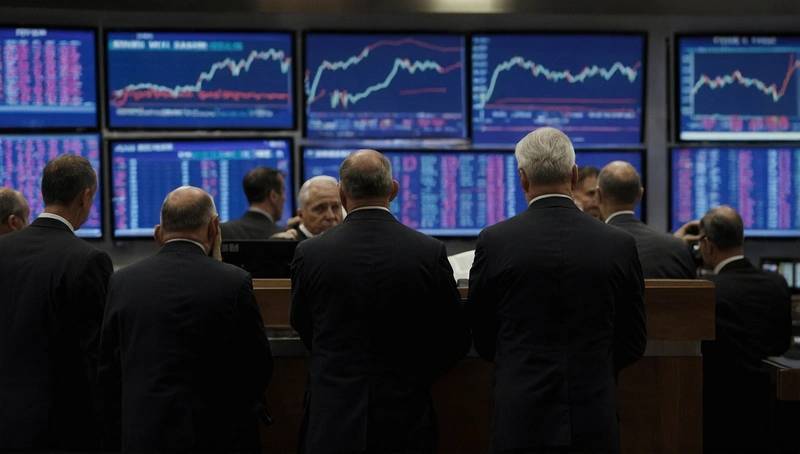
The global stock market got a boost Thursday thanks to a series of positive earnings reports that helped offset some of the gloom in Wall Street due to a lacklustre performance by tech megacaps. Oil prices also rose following U.S. sanction against Russia.
After the U.S. placed sanctions on Rosneft, and Lukoil, two major Russian oil companies over the Ukraine conflict.
The STOXX 600 index rose 0.3% for the day, as positive earnings helped to boost the domestic indexes.
The MSCI All-World Index, however, has slipped into the negative zone, and is on its way to its third consecutive day of decline.
Chinese stocks dropped as much as 1,1% after sources reported that the White House was considering a plan aimed at curbing a range of software-powered products exported to China as retaliation against Beijing's recent round of restrictions on rare earth exports.
Investors are on the defensive as Trump's Asia trip (next Monday) is causing geopolitical tensions, according to Charu Chanana of Saxo Bank, Singapore.
The talk about U.S. software import curbs to China is hitting tech sentiment where it hurts. And renewed sanctions against Russia are a reminder of geopolitical risk that's not going away.
Positive Earnings Surprises
As earnings season begins, global equity markets are beginning to ease off their record highs. Although there have been some disappointing results or outlooks for megacaps, the majority of companies have so far surpassed analysts' expectations.
Futures for the S&P 500, Nasdaq and Dow Jones were up between 0.1-0.2%.
Tesla shares fell around 4% on Thursday morning after the company missed profit expectations despite a record third quarter revenue.
There was still plenty of tech to be excited about. Shares of IonQ Computing, Rigetti Computing, and D-Wave Quantum jumped more than 20% after a report in the Wall Street Journal stating that the U.S. Government is in negotiations with several quantum-computing firms to exchange stakes for federal funding.
After U.S. president Donald Trump imposed sanctions on Ukraine for the first time during his second term, oil rose by 3% to $64.68 per barrel. On the same day, EU member states approved a 19th set of sanctions against Moscow which included a ban on Russian imports of liquefied gas.
Kyle Rodda is a senior analyst at Capital.com, in Melbourne. "Most Asian countries are net energy consumers, which is just a way to slow down growth and drive inflation."
Reliance Industries, India's largest importer of Russian oil, plans to drastically reduce its imports in response to EU and U.S. sanction. Other Indian refiners are also expected to make significant reductions.
DO NOT UNDERESTIMATE THE MAGIC OF RATE CUTS
Investors' firm belief that the Federal Reserve will soon be on a rate-cutting frenzy helps to ease some of the anxiety over geopolitical tensions and trade conflicts. The markets show that traders expect U.S. interest rates to fall from 4% at the moment to 3% in June.
"Never underestimate a Fed which cuts rates, and also the magic word: ending QT", IG Chief Market Analyst Chris Beauchamp, referring the central bank's programme of quantitative tightening, in which it reduces its holdings of Government Bonds to tighten up credit conditions.
The dollar index which compares the U.S. dollar to six other currencies, rose 0.1% last week. It has been steadily rising since August when it hit a three-and-a half year low. Investors are more confident that the Fed will protect the economy.
Gold, on its way to its largest weekly decline since May, rose 0.4% per day, reaching $4,110 for an ounce. Overnight, the price briefly approached $4,000 as investors took profits in anticipation of U.S. Inflation data this week.
(source: Reuters)