
Latest News
-
US States sue Trump Administration for weakening endangered animal protections
On Wednesday, two U.S. state filed lawsuits accusing President Donald Trump's administration?of illegally weakening federal Endangered Species Act. This landmark law has protected the bald?eagle from the dangers posed by the development. In a?one? lawsuit, states challenged a law that narrowed a definition of harm. This had included habitats where animals were endangered. Oil drilling, mining, and other activities are allowed in these habitats as long as they do not directly harm or kill the animals. Two rules are at issue in the other lawsuit. The first rule "eliminates protections for new threatened species, unless the U.S. Fish and Wildlife Service will create species-specific protections. The second rule states that the government must consider objections from developers, fossil-fuel companies and other businesses prior to declaring areas as "critical habitats." Letitia J., New York Attorney general, said that the attorneys general of 20 states as well as the District of Columbia filed one or both lawsuits. The Endangered Species Act, passed by Congress in 1973 has been credited for saving a number of animals, including the California Condor, Grizzly Bear and Humpback Whale from extinction. Trump's goal is to reduce regulations, which he claims are a constraint on American businesses. This includes the scaling back of various environmental initiatives and standards. Wildlife advocates often consider habitat destruction to be the leading cause of animal extinction. Interior Secretary Doug 'Burgum said that the Endangered Species Act had been "weaponized". This has weakened competitiveness, undermined national security and hurt Americans' pockets. He said that the new rules aligned the law more closely with its original intention. The changes are a result of the U.S. Supreme Court ruling in 2024 that overruled a precedent dating back 40 years, which required courts to give deference to federal agencies reasonable interpretations on laws they administer.
-
GE Aerospace's jet engine supply is dependent on the 'black arts' of castings
GE Aerospace, a leader in the aerospace industry, has acted to reduce shortages of precision parts for jet engines while securing valuable technologies. It did this by purchasing Consolidated Precision Products at a price of $12 billion. The purchase of CPP, the world's third largest manufacturer of metallic components for engine blades, is part and parcel of a long-term effort to improve aerospace supply chains. Larry Culp of GE Aerospace, who announced his largest acquisition after splitting the industrial giant General Electric and turning it around, described this capacity as "mission-critical". The deal shows a shift in focus from winning new orders towards production strategy for the aerospace industry. Its biggest challenge is to deliver on order books that are seven to ten years old. INDUSTRIAL CHOKEPOINT Since the COVID-19 pandemic, castings -- which are parts made of liquid metal but difficult to produce in large quantities -- and forgings (which are made of solid metal, and equally hard to manufacture) have been the most stubborn chokepoints within the industry. GE's competitors also want to?address this issue. Pratt & Whitney announced last year that it would be adding a casting foundry to its North Carolina facility, while Rolls-Royce will expand an existing British plant. Analysts say that turbine blades are the most expensive aerospace products because they use a combination of age-old techniques, such as?wax replications, and cutting-edge technology to resist temperatures above their melting points. The engines have also been the source of larger?production snags that fuel tensions between the airline industry and the engine industry. The few players who have invested and acquired specialist knowledge over decades are difficult to copy and keep prices high. Kevin Michaels, Managing Director of AeroDynamic Advisory, said: "It is the black art?of manufacturing that has always been a big barrier." "It's the hardest thing to make a new design... you might have to throw out half or more of your work (to create a new one)," he said. Jefferies reports that CPP is among the four largest global suppliers of such castings, and provides a quarter GE's requirements. Industry sources claim that GE has been courting the Ohio-based company for many years, as it seeks to insure against disruptions from larger suppliers Howmet and Precision Castparts Corp. DEAL WILL BE ANTITRUST SCRUTINED Bottlenecks are not the only reason for expansion. GE plans to utilize its LEAN Production System to increase efficiency and reap greater rewards. Analysts claim that the IPO and turnaround of UK counterpart Doncasters set a new tone. A strategic competition between engine developers is also centered around castings and forgings. Michaels stated that China also wants a piece of the market. Jerrold Lundquist of The Lundquist Group said that GE is expecting a financial return from the deal. It also gives them the opportunity to own a critical piece of the engine supply chain. Elon Musk highlighted the broader?competition in advanced metal parts last week when he posted that SpaceX's plans to manage separate?castings on-site would be "a profound game-changer". Deals such as GE's do not come without risk. Deals like GE's are not without risk. Howmet CEO John Plant stated on Wednesday that he was "fine with the deal". The deal will also be subject to?antitrust review. GE will likely point out its ownership of Italian gear manufacturer Avio Aero, a major Pratt & Whitney supplier. Matteo Peraldo is an aerospace and defense partner with U.S. based AlixPartners. He said: "I expect GE will be required to divest some facilities, making integration and any carve outs related to that process quite complex."
-
US to help Kenya develop its critical mineral processing
A senior American official stated on Wednesday that the United States would help Kenya develop an important minerals processing industry. This was in response to the rivalry between China &?the US. Over access to essential minerals. Kenya is considering bids for the development of Mrima Hill, a coastal deposit that is estimated to contain rare earth minerals worth tens and billions of dollars, as well as niobium - a metal commonly used in aerospace manufacturing. Frank Garcia, Assistant Secretary of State for Africa, said at a meeting of a Kenyan business lobby group, the American Chamber of Commerce, that "critical minerals" are a priority for both President (Donald Trump) Trump and Secretary of State (Marco) Rubio. We are prepared to work with Kenya in order for it to become a regional leader. We are ready to assist you in building a mining sector that is transparent, attracts legitimate business, respects the communities and secures global supply chains. U.S. U.S. U.S. International Development Finance Corporation?supports a pipeline African rare earth project as Washington tries to reduce its dependence on the top producer China. China dominates global supply chains and has tightened their export controls in recent years. Garcia stated that "if we are serious about rare Earths minerals, energy, and a stronger America we do it together, not alone." William Ruto, Kenya's president, welcomed the U.S. assistance and said that local processing of minerals would help his government to create jobs. Ruto said at the same meeting that "in critical minerals we are accelerating responsible exploration and the development of rare earth elements, titanium graphite, Lithium, Niobium, and other strategic resources". In July, Critical Metals Corp. and RareX Australia announced that they were shortlisted for the rights to Mrima hill. Harry Kimtai said that the Kenyan government had not released a shortlist, but six companies were on it, with two from the United States, he added. U.S. Official says he rejects the extractive model Chris Kulukundis said that the U.S. and Kenya have reached an agreement on how to develop the mining sector. The Mrima?Hill procurement process is?moving in a transparent way. He said that two U.S. consortiums were being considered for the tender process. If selected, they would be able to complete the project the right way. Ruto said in June that Kenyan and U.S. officials were nearing the completion of a crucial minerals deal. On Wednesday, neither side gave an update. Garcia stated that the United States favored a mining model which includes local processing in producing countries and value addition. He said that some of his competitors were "efficient" at only one thing, which was to pull minerals from the ground and whisk them offshore. They then captured all the value added far from the land from where the minerals came from. China has denied the accusations made by some governments and advocacy organizations about its export of raw minerals to be processed elsewhere.
-
Portugal purchases power and gas company REN in order to protect strategic assets and influence investments
Portugal's Government said Wednesday that it?bought a share in the power and /gas grid operator REN?to safeguard its strategic assets amidst growing geopolitical uncertainties and?gain a greater influence over?key investment. Last month, the state agreed to purchase 13.7% of REN. This is a return to the company after 12 years when it left during Portugal's bailout. During this time, China's State Grid acquired a 25% stake, becoming its?largest investor. The Environment Minister Maria da Graca Carvalho stated that Portugal has maintained a "good 'dialogue and cooperatio" with the Chinese company. However, she said the decision was based on considerations such as sovereignty, national interest, security, and geostrategic. She told a committee of parliament that "whether it's this state-owned firm?or another one from another country, the constant geopolitical changes?we've seen in recent months cannot be ignored." She stated that in light of the growing geopolitical uncertainties, it is important to control REN’s strategic assets - the electricity and natural gas transmission networks, and the gas storage infrastructure - especially when ownership is outside the European Union. She said: "We have European and national laws that allow us to act, particularly in matters of security and sovereignty, as a preventative measure?against the?highly unpredictable geopolitical climate today." She added that the stake would increase the state's "influence 'from within'" investments aimed to expand REN's?grid of electricity, and speed up connections for new wind and solar projects. This, she said, would 'help lower electricity costs and boost 'the economy's competition. She said, "We have a long list?of major investments that are dependent on the availability and reliability of the grid for electricity in Portugal."
-
US to help Kenya develop its critical mineral processing
A senior American official said on Wednesday that the United States would help Kenya develop an important minerals processing industry, in the context of a 'rivalry between China and America over access to vital minerals. Kenya is considering bids for the development of Mrima Hill, a coastal deposit that is estimated to contain rare earth minerals worth tens and billions of dollars, as well as niobium - a metal commonly used in aerospace manufacturing. Frank Garcia, assistant secretary of state for Africa at the American Chamber of Commerce in Kenya, said: "Critical Minerals are a priority for President (Donald Trump) Trump and Secretary of State Marco (Rubio). We are prepared to work with Kenya, as it becomes regional leader in this area." "We're ready to help you create a transparent mining sector that attracts legitimate business, respects local communities and secures global supply chains." U.S. U.S. U.S. International Development Finance Corporation supports a pipeline of African Rare Earth?projects, as Washington aims to reduce?dependence from top producer China. China dominates the global supply chains and has tightened its export controls over recent years. Garcia stated that "if we are serious about rare Earths minerals, energy, and a stronger America we do it together, not alone." William Ruto, Kenya's president, welcomed the U.S. assistance and said that local processing of minerals would help his government to create jobs. Ruto said at the same meeting that "in critical minerals we are accelerating responsible exploration and development" of rare-earth element, titanium, graphite and lithium. In?July, Critical Metals Corp. and RareX.com.au announced that they were shortlisted for the right to develop Mrima Hill. Kenya's government is yet to publish a list of shortlisted companies. Ruto said in June that Kenya was close to completing a crucial minerals deal with the U.S. On Wednesday, neither side gave an update on the deal. Garcia stated that the United States favored a mining development model which includes local processing in producing countries and value addition. He said that some of his competitors were efficient in one area: they could extract minerals from the ground and whisk them off to offshore locations, where they would capture all the value added far from the lands the minerals came from. China has denied the accusations made by some governments and advocacy organizations about its export of raw minerals to be processed elsewhere.
-
Data shows that despite the 'dark crossings,' one third of Gulf Oil is still missing.
* The global shortage of uranium has been eased by clandestine shipments Oil prices have risen because of the uncertainty over oil volumes * Difference between peak daily flows and the average Dmitry Zhdannikov & Anushree Mukerjee LONDON, September?9, - Estimates of Middle Eastern oil flows have been wildly varying since tankers started "dark crossings", meaning that they sail without transponder signals, to avoid Iranian attacks. The clandestine "shipments" have greatly increased supplies while the incertitude over their scope has added to the premium on international oil prices. Last week, U.S. Diesel prices reached a record high. Last week, the U.S. Energy Secretary said that shipments had almost returned to their previous levels before U.S. and Israeli attacks on Iran in February?launched an energy war which has severely disrupted flows. The data analysed by indicates that the industry consensus is around two-thirds pre-war volume. This includes estimates of the amount of oil shipped by ships sailing without their Automatic Identification System (AIS) transponders as part of what ship trackers and analysts have called "the world's biggest clandestine operation", organised with U.S. Military support. Goldman Sachs analysts estimated in a note dated September 2, that the total Gulf oil exports including "dark crosses" were between 15 and 16 million barrels of oil per day. This is about two thirds of pre-war levels. The London-based analytical company Vortexa estimated that total oil exports in the Gulf region were 15 million barrels per day (bpd) in August. This is still 10 million barrels below pre-war levels. The company reported that the crude and refined product volumes passing through the Strait of Hormuz were approximately 8 million bpd on a moving average basis of seven days. Pamela Munger, analyst at Vortexa, said that "daily transits fluctuate with significant spikes and troughs." U.S. Energy Sec. Chris Wright clarified the 17 to 18 million barrels number on Fox?News Sunday, saying that the 18 million bpd figure was for a 24-hour period of last week. Wright said that the running average of all "waterborne" routes was 9 million bpd. This is closer to the industry consensus. Analysts have also found a discrepancy in the daily peak flows and sustained exports. Gulf crude exports were as high as 14 million bpd in some days of early September. This includes secret tanker flows, Saudi Red Sea exports, and exports from the Gulf that bypassed the Strait of Hormuz. Exports can be much lower on some days depending on the intensity and frequency of Iran's attacks on tankers. Covert shipments are now a regular occurrence and allow crude oil from Iraq, Kuwait and Qatar to reach global markets. Calculations based on an average oil price per barrel of $80 and a conservative assumption that 6 million barrels or six large tanks were shipped each day for the past 90 days found that dark shipments totaled at least 500 millions barrels from June to August. This would amount to at least $40 billion.
-
Brazil releases $1.3 billion in fuel subsidies
According to a 'executive order' signed by President Luiz Inacio Lula on Wednesday when the gasoline subsidy was due to expire, the Brazilian government allocated an extra 6.6 billion reais ($1.3 billion) to fuel subsidies. The order allocates 5.6 billion reais for subsidizing diesel fuels used on roads, and the remaining 998 millions reais are allocated to subsidize oil-based fuels production and import. Lula's government has crafted a series of fuel-related measures, as part of a broader relief plan set up since the beginning of?the U.S. and Israeli war against?Iran. Leftist leader tries to reduce the impact on domestic consumers of rising global oil prices ahead of October's election when he seeks another four-year mandate. The previous gasoline subsidy, which was extended in August, will expire Wednesday. The?government eliminated part of the diesel subsidy in June when oil prices fell, but this external relief was only temporary, and the conflict continues. Brent crude futures surpassed $100 per barrel for the first since July 24. This was a six-week record high as the Middle East escalated, raising concerns about disruptions in global oil supply.
-
Middle East tensions drive oil over $100, Wall Street drops
Brent crude prices soared to $100 per barrel on Wednesday, and Wall Street opened lower as the escalating conflict engulfing the Middle East fueled fears?about? energy-driven inflation in advance of several important central bank decisions. Brent crude futures climbed as high as 3%, reaching a session-high of $100.95. This was the first time that Brent crude had breached the symbol since July 24. After Iran claimed it fired missiles at an American base in Jordan, and both sides claimed they attacked vessels, oil supply from the region became a concern. Brent crude prices rose by 2.83% at the start of U.S. trade, and were priced at $100.70 per barrel. The stock markets around the world were under pressure due to the recent surge in energy costs, which prompted concerns that central banks would tighten monetary policy for longer if inflation continues to rise. The Dow Jones Industrial Average fell by 0.75% during early trading. Meanwhile, the S&P 500 was down by 0.30% while the Nasdaq Composite dropped by 0.35%. The pan-European STOXX 600 Index?fell 1.2% while MSCI's global stock index fell 3.39 points or 0.29%. The euro edged up ahead of Thursday's policy announcement by the European Central Bank. Markets were expecting an increase amid inflationary pressures caused by the Iran War. The currency reached a new high of $1.16493, which is more than a week old. As traders redeemed short positions, the yen reached a 'nearly 7-month high' against the dollar on Tuesday. The Bank of Japan is expected to increase rates faster and there could be a rush of Japanese capital repatriated. Japan and the Eurozone are both energy importers. The dollar index fell by 0.13%, to 98.65, measuring the greenback in relation to a basket including the yen, the euro and other currencies. U.S. INFLATION TESTS The benchmark yield for global borrowing costs is the 10-year U.S. Treasury. It traded at 4,794%. Last week, it reached a high of nearly three years at 4.818% as traders ramped up expectations of tighter monetary policies. The U.S. consumer and producer price reports that will be released this week are a test of these bets. Policymakers are looking for more evidence that inflation is continuing to cool. In the latest survey, 70% of economists expect that the Federal Reserve will keep rates the same at its rate-setting meeting on Tuesday. However, this is lower than the 90% of economists who expected rates to remain the same in August. Matthew Ryan, the Head of Market Strategy for global financial services company?Ebury, said: "Financial market participants are genuinely divided on whether or not the FOMC will increase rates at its September meeting next week, a state of 'uncertainty that is unusually close to a deadline. The yen gained around 0.4%, reaching 153.350 to the dollar. It is now back at its previous high of 152.89. The yen had risen by around 4% in the last five days, with BOJ officials' hawkish comments ostensibly triggering a move which?then snowballed when breaks of key levels led to additional buying. Sterling edged up 0.14%. The Bank of England will announce its latest decision on Thursday of the following week. Economists predict that the key rate for the rest of the year will remain unchanged. Gold rose 1.5% to $4,418 per ounce.
European stocks are boosted by optimism about Ukraine, but trade tensions persist
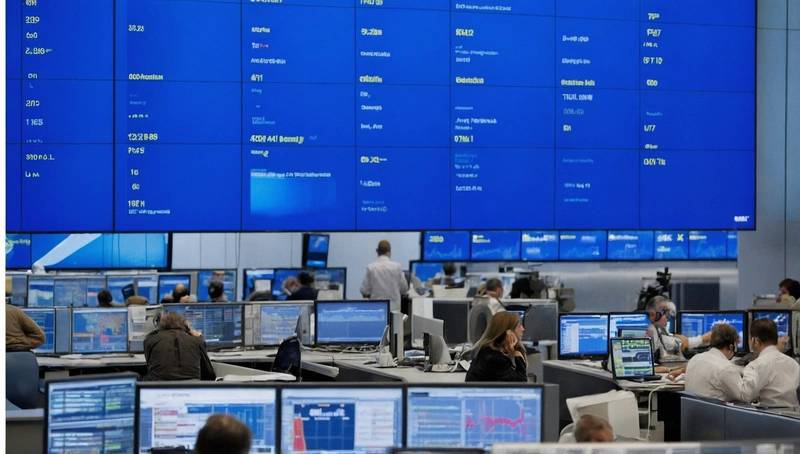
The euro was near its five-month high in the early European trading of Wednesday, with news that Ukraine will support a U.S. plan for a 30 day ceasefire. However, traders were cautious due to fears over U.S. tariffs.
Wall Street was left in a state of confusion on Tuesday, after U.S. president Donald Trump had threatened to double the steel and aluminum tariffs against Canada to 50%. He then reversed his decision.
The U.S. indexes recovered a portion of their losses in the later session, and European futures rose after Kyiv announced it would accept the U.S. ceasefire offer and the U.S. stated it would resume military aid to Ukraine and intelligence sharing.
At 1032 GMT on Tuesday, Europe's STOXX 600 index was up 0.8% for the day. This is a turnaround from four days in a row of losses.
The DAX in Germany and the FTSE 100 in London both rose by 1.4%.
The MSCI World Equity Index, which had lost 4.1% this month so far, rose 0.1% for the day.
The stock market has been hit by its worst selling in many months as Trump's tariff focus since taking office, in January, has hurt consumer confidence and businesses. It also sparked fears of an upcoming U.S. economic recession.
Trump's tariffs against all U.S. imports of steel and aluminum took effect on March 1. The European Commission responded by announcing that it would implement counter-tariffs for U.S. products worth 28.40 billion euros (26 billion dollars) starting next month.
Amelie Derambure is the senior multi-assets manager at Amundi. It's Europe's largest asset manager.
The news is a bit painful for the markets, because tariffs are the main topic. We know that they're bad for growth, not only for the U.S. but also the rest of the globe.
EURO NEAR FIVE MONTH HIGH
The U.S. Dollar Index was barely changed at 103.52, while the euro reached its highest level in five months, $1.0913. This was aided by the Ukraine-related news. The Russian rouble hit a six-month high Tuesday but fell back on Wednesday.
Derambure, Amundi's Derambure, said that the risk premia embedded in the euro currency due to low growth, political unrest, etc., has been declining very quickly.
The yields on government bonds in the euro zone rose. The benchmark German Bund yield was near a 17 month high, as Germany's next likely chancellor Friedrich Merz worked to gain support for an increase in state borrowing. Germany's plans to overhaul borrowing rules and create a 500-billion euro infrastructure fund are expected to lead to structurally higher yields on its bonds.
The German 10-year bond yield has increased by 5 basis points to 2.924%.
Oil prices rose due to a weaker dollar. However, gains were limited because of fears about a U.S. slowdown, and the impact of tariffs on global growth.
Brent futures rose 1.1% to $70.31 a barrel, while U.S. West Texas intermediate crude futures increased 1.2% to $67.02 a barrel.
The markets are awaiting the U.S. CPI report due at 1230 GMT. It is expected that inflation will be cooling.
The Canadian central bank's meeting will also be watched by traders, as markets expect a seventh consecutive cut in interest rates. ($1 = 0.9215 euros) (Reporting from Elizabeth Howcroft in Paris; additional reporting by Tom Westbrook, Singapore; editing by Alex Richardson).
(source: Reuters)