
Latest News
-
Ampol shares reach a 2-year high after refining margins triple
Ampol, an Australian company, said that its Lytton refinery's margins more than tripled in the 2nd quarter. This was boosted by the surging oil prices linked to the Middle East war, which pushed the shares of the company to their highest levels in over two years. Ampol reported that the prolonged closure of Strait of Hormuz has tightened crude supply to Asian refiners. This has reduced refinery activity, and driven up refined fuel margins because of product shortages. Ampol stated that it was in a good position to handle any conflict as they had secured supplies for the majority of the quarter. The top fuel retailer in the country reported a 255% increase in its Lytton refinery margins for the second quarter, from $8.71 per barrel a year earlier to $30.93. The total volume of group sales fell from 6,304 million litres to 6,176 millions litres. Mark Elzayed said that the earnings strength was driven primarily by exceptional refining profit margins, rather than a broad-based growth in volume. Elzayed warned that a sustained easing of tensions in the Strait of Hormuz area could lower geopolitical risks and reduce refining margins to longer-term averages, posing a risk to Lytton’s refining earnings. The shares of the company rose 0.6% at 0418 GMT, after gaining as much as 3.4% in the previous session. Ampol announced that its Lytton Refinery will be closed between August and October to perform maintenance. It expects this to result in a reduction of annual production of about 300 million litres. The company will'manage reductions through its diversified sources of supply, import infrastructure and trading capabilities. Elzayed stated that the company's first-half earnings should be sufficient to allow it to fund the Lytton Refinery turnaround with internal cash flow. Fuel retailer reported that its first-half RCOP EBIT was A$1.35billion ($965m) on a non-audited basis. This is more than tripled from the year before.
-
Asian stocks falter after a deep crash, and the Fed leaves markets in the dark about interest rates
Asian stocks were volatile on Thursday, after a week filled with?market turmoil sparked by AI fears. A divided Federal Reserve remained steadfast on interest rates and left the bond markets unsure of their next move. Brent 'futures' fell below $90 a barrel after a day of turbulence sparked by AI jitters. The Federal Reserve, divided, remained steadfast on rates and left bond markets uncertain about the next move. Investors were confused by the Fed's split decision on whether it would raise rates to combat inflation. The yields on U.S. Treasuries with longer maturities rose to their highest level in 19 years. Nasdaq Futures rose by 0.4%, while European Futures indicated a muted opening. Investors will focus on the Bank of England's policy announcement, which is expected to remain unchanged. MSCI's broadest Asia-Pacific share index outside Japan fell 0.6% last after swinging between gains and losses throughout the session. Japan's Nikkei index was up 0.24%, but is still on track for a weekly drop of 4%. Asian chipmakers were the focus of attention in the past week, after a brutal selloff on South Korean stocks wiped out more than $2 trillion from the market value. This heightened investor concern over the return on AI investments. Vasu Menon is the managing director for investment strategy at OCBC. He said that the markets will remain volatile in the short term due to the uncertainty surrounding U.S. policy and the steepening curve of Treasury yields. VOLATILE KOSPI - SHOWING NO SIGN OF EASING? The KOSPI fell 1% during choppy trades, and was on course for a weekly drop of 15%. This selloff prompted Finance Minister Koo Yon-cheol?to apologize for the introduction of single-stock leveraged exchange-traded funds, which led?authorities?to unveil measures to stabilize the market. Gina Kim is the portfolio manager of emerging market equity at Nordea Asset Management, Singapore. She said: "Given the fact that the fundamental thesis has not changed, it does seem like there's a panicky, irrational element to the current sales." Samsung Electronics, which posted a 250-fold increase in chip profits to ease some nervousness, said that it expects the chip shortages will worsen and continue into 2028. The earnings reports of Microsoft and Meta, two megacaps in the AI race, showed starkly different fortunes. Microsoft's shares rose after it assured investors that they would continue to generate cash until fiscal 2027, despite its heavy spending. Meta's share price fell, however, following a 91% decline in free cash flow for the second quarter. The earnings from Apple and Amazon on Thursday will give more clarity about the sustainability of the AI market. FED LOOK TO MARKETS AS CUES Kevin Warsh, Fed chair, spoke at a media conference after the meeting. He promised to control inflation. However, he did not give any indications of what steps the central banks might take. Warsh pointed out that bond yields have risen significantly since the Fed’s last policy meeting. This reflects market expectations for higher interest rates. He welcomed the move while stressing it didn't oblige the Fed to confirm those expectations through policy actions. Blerina Uruci, T. Rowe Price's chief U.S. economics officer said: "To me, this is a sign that the market has already done the Fed’s job." Warsh's hawkish tones?will ultimately not be enough?to ensure price stability. The market will soon learn that Warsh, the FOMC and their lack of forward guidance will not deliver a policy outcome simply because the market priced it. The confusion caused the yields of 30-year U.S. Bonds to fall from their peak in June 2007 (5.2273%) late in New York Trading. Fed funds futures now indicate that there is a 60% probability the Fed will?raise rates at its September meeting and have 33 basis points of tightening already priced in. Kerry Craig, global asset manager at J.P. Morgan Asset Management and J.P. Morgan Asset Management's strategist for global markets, said that the Fed will continue to be questioned about its credibility. The gap between the Fed’s words and actions could pose a problem for market pricing. A new chair is faced with a divided committee, and a bond markets that are beginning to doubt the central bank's determination. (Reporting and editing by Ankur Banerjee, Rae Wee and Lincoln Feast in Singapore.
-
Wall Street Journal, July 30,
These are the most popular stories in the Wall Street Journal. The?Wall Street Journal has not?verified these stories or?cannot vouch?for?their accuracy. American?forces?launched strikes against Iran Wednesday night in response to Iran's missile attack on U.S. troops in Jordan. The Pentagon has allocated a total of?more that $120 billion to contractors for the production of Patriot missiles and submarines. Lockheed Martin's contract with Patriot is now worth nearly $59 billion. The Energy Department’s Paducah facility in western Kentucky will be home to a?$100 billion AI data center. Grant Thornton Advisors, a provider of tax and advisory services, has agreed to take CBIZ private for more than $3 billion in cash. -Johnson & Johnson has reached a strategic deal with Sail Biomedicines in order to advance 'its immune-mediated diseases program. They were granted a 'exclusive?option to purchase Sail for $2.58billion. The Justice Department filed a lawsuit against a U.S. judge, Zahid Quraishi, to force the state of New Jersey to release its voter lists without redactions. Starbucks is accelerating U.S. service times by increasing cafe 'labor' and using an algorithm for calculating?orders. U.S. store staffing levels are nearly 100%, with 98% of the scheduled shifts being filled. (Compiled by Bengaluru Newsroom)
-
ArcelorMittal's earnings are up as European safeguards pay off
?ArcelorMittal, the world's second-largest steelmaker, reported slightly stronger-than-expected ?core earnings on ?Thursday, ?saying its European ?business is gathering momentum thanks to the EU's safeguards. The Luxembourg-based firm posted core earnings for the second quarter of $2,06 billion. This was higher than the $2.01billion expected by analysts surveyed by?LSEG. Steelmakers in Europe have recently benefitted from a recent protectionist drive. The EU is trying to protect their local production from cheaper Asian imports by imposing a carbon tax on imports that are high-emission. The company believes that the new safeguards are going to support a higher capacity utilization in Europe and restore profitability. Aditya Mittal, CEO of the company, said that the company expects to see higher shipments both in the third quarter and second half of the year. ArcelorMittal reported that it had increased its 'crude steel production' in Europe by about 11% in comparison to the first quarter. This was mainly due to the re-starting of production facilities in Spain and the restarting of a blast furnace in Poland in response the improving demand. Reporting by Javi Larranaga, Gdansk; editing by Milla Nissi-Prussak
-
Heidelberg Materials lowers profit forecast due to higher energy costs
Heidelberg Materials said that it expects the war in Iran to further increase energy costs for this year. The German cement manufacturer also lowered its profit forecasts for 2026. The group stated that inflation and high financing costs would continue to have a negative impact on global residential construction. High energy costs were also cited as a major factor. Even though CEO Dominik von Achten highlighted "a?environment which remains geopolitically & economically'very challenging", he said that there were still first signs of a visible demand recovery in the core markets. Heidelberg Materials expects to see its operating profit drop from EUR3.40 to EUR3.65 billion (USD3.89 to $4.18) to EUR3,40 to EUR3.65 billion. This is a decrease from the previous range between EUR3.40 and EUR3.75 billion. According to an?evaluation provided by the company the operating profit of the group is expected to be EUR3.51 billion. This would represent a 4% growth year-on-year. $1 = 0.8733 Euros (Reporting and Editing by Ludwig Burger).
-
Gold falls as Treasury yields rise and offset the focus on Warsh’s inflation message
Gold prices fell on Thursday due to higher U.S. Treasury yields. Markets also assessed Kevin Warsh's comments on the Federal Reserve's efforts to combat inflation following its decision this week not change interest rates. As of 0445 GMT spot gold was down by 0.4%, at $4,048.39 an ounce. It had risen as high as 2% the previous session. U.S. Gold futures for August delivery rose 0.3% to $4.045.70. The yields on the benchmark U.S. Treasury 10-year note increased, increasing 'the opportunity cost' of holding gold. Soni Kumari, an ANZ analyst, said that "yields are a product of rate expectations." If the market believes that inflation fears will lead to higher rates, then yields will rise. This will put pressure on gold. The Federal Reserve, divided on its policy direction, left interest rates unchanged Wednesday. Warsh reiterated the central bank's commitment?to?bringing inflation under?control. This uncertainty about the next move of the Federal Reserve has left markets in a state of uncertainty. Gold is seen as a hedge against inflation, but it loses appeal in an environment with high interest rates as a non yielding asset. According to CME Group’s FedWatch tool, the markets still price in a 65% probability of a rate increase in September. This is down from 81% just before?the policy announcement. Investors also await the U.S. The Personal Consumption Expenditure data (PCE), due at 1230 GMT. The U.S. conducted fresh strikes on Iran's?geopolitical side? on Wednesday. The military said that the war, which has been raging for five months, was intensifying. It had already spread beyond its main fronts and into other countries in the area. Oil prices?lost some of their gains as oil tankers?continued their journey out of the Middle East on Thursday. Analysts at TD Securities wrote in a report that the yellow metal was likely to drift?back?towards $3,900 an ounce because oil is still?under pressure?to move even higher 'throughout the summer. Spot silver dropped 0.6%, to $57.30 an ounce. Platinum fell 1.1%, to $1.593.77. Palladium increased 0.6% to $1253.25.
-
Morning bid Europe-Bond markets do the Fed's job
Ankur Banerjee gives a look at what the markets will be like in Europe and globally. A divided Federal Reserve and a confusing message by Chair Kevin 'Warsh about where rates are heading has left the bond market scratching their heads and'somehow in control, in an 'odd reversal which raises questions regarding the credibility of the central bank. As expected, the U.S. Central Bank did nothing, but three dissenters highlighted the growing divide between policymakers about the next steps to combat inflation, which remains above the Fed’s target of 2 percent. Warsh pledged to contain inflation, but did not give any indications of what steps the central banks might take. He noted that bond yields have risen significantly since the Fed’s last policy meeting and reflect market expectations for higher interest rates. He praised the rise in short-term bonds yields while stressing it didn't oblige the Fed with policy actions to validate these expectations. It is not good for a central bank to talk about its independence and then do nothing. Ed Yardeni, a Wall Street veteran, said that "talking hawkish and not acting in this way reduces the Fed’s credibility." "We conclude that in order to reduce long-term interest rates, the Fed must raise short-term rate." Bond investors changed the dynamic on Thursday as the Treasury curve steepened. The yield on inflation-sensitive U.S. 30-year bonds has reached its highest level in 19 years. Fears about the AI market kept sentiment fragile. However, the selloff on Friday was not as steep as it had been earlier in the week. The earnings from Microsoft and Samsung helped to'soothe nerves, but the?huge decline in Meta cash flows highlighted that these firms are struggling to make money on their massive investments. The Bank of England will announce its policy in the European 'hours. It is likely that the central bank will keep interest rates unchanged as it considers the impact of Iran 'war, which has shut the Strait of Hormuz since last May and increased inflation pressures. The following are the key developments that may influence markets on Thursday. Economic events: Bank of England decision on policy, Q2 GDP, and July sentiment data in the euro zone. July inflation for Germany. (By Ankur Bhanerjee, Singapore)
-
Oil prices fall as markets watch for clues about Gulf supplies
The oil prices lost some of their gains on Thursday despite the escalating attacks across the Gulf. Investors' attention shifted to the supply flow through the major chokepoints within the region. Brent futures dropped 96 cents or 1.06% to $89.78 per barrel as of 0418 GMT. U.S. West Texas Intermediate (WTI), crude oil, fell 64 cents or 0.76% to $83.82 per barrel. Brent and WTI both rose by 6.56% during the previous session, one of the biggest spikes in the Iran War. This was after the pause of hostilities that occurred on Tuesday following a 5% drop. The prices of gasoline and diesel rose after U.S. president Donald Trump warned on Wednesday that he would hit Iran "very, very hard"? following an Iranian missile strike on Tuesday against a U.S. military base in Jordan. In retaliation to drone attacks launched by Iraq against?Saudi oil sites, the U.S., Saudi Arabia and other countries attacked paramilitary groups in Iraq backed by Iran. This was the first time Saudi Arabia had publicly joined U.S. aerial strikes. U.S. Central Command reported that the U.S. carried out attacks against Iran for two hours on Wednesday. This?ended the lull of U.S. attacks on Iran which began at the weekend. "Trump's hit hard' rhetoric caused the price spike instantly but it looks like the market has fully priced in (that) and is considering the TACO possibility right now," Lin Ye, vice-president of commodity markets for oil at Rystad, said. She was referring to Trump Always Chickens out. Ye said that the market follows a pattern. Geopolitical headlines trigger rapid price spikes. However, these gains are usually short-lived because actual supply flows and simultaneous diplomatic efforts determine how long they persist. The price of crude oil is being controlled as it continues to flow from the Gulf region, despite the Strait of Hormuz almost shutting down. Iran shut down the waterway - through which a fifth or more of the global oil and natural gas flowed before - after the U.S. vs. Israel 'war' began on February 28. Rystad Energy estimates that about 13 million barrels of oil per day from the Gulf still reach markets. Even after the Iran-aligned Houthis of?Yemen imposed a Naval Blockade on Saudi Arabia on the Red Sea, July?20 disrupting shipping through the Bab el-Mandeb strait. Some cargoes have still flown to the markets, especially on tankers connected with China. While overall volumes have been reduced, oil continues to leak out through a variety of channels. Additional workarounds are also being explored. In a note, IG analyst Tony Sycamore stated that the 'longer this situation continues, the more these alternate routes and methods will erode Iran’s leverage over Strait of Hormuz. Reporting by Mohi N. Narayan and Colleen H. Howe, Beijing. Editing by Lincoln Feast & Christian Schmollinger.
EU countries want more flexibility in gas storage targets
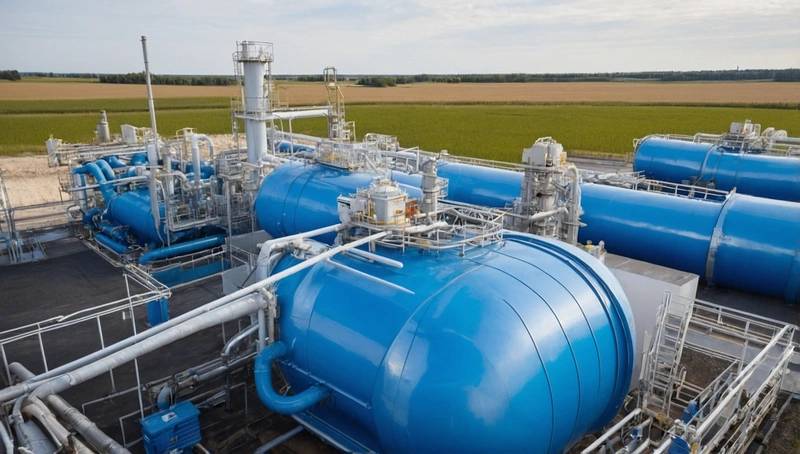
EU diplomats have revealed that European Union countries are pushing back against a plan by the European Commission to extend the binding storage goals of the bloc for another two years. They want the goals to be more flexible.
The European Commission proposed on Wednesday to keep Europe's binding goals to fill up gas storage until the year 2027. This was in response to calls from certain countries to soften them, but the EU executive said it would be more lenient when enforcing the targets.
EU diplomats said that this did not satisfy the concerns of certain member countries who, at a Thursday meeting of diplomats of EU countries, demanded greater flexibility in the rules.
Germany and the Netherlands have warned that the EU's requirements for filling storage tanks are driving up gas prices by signaling to the market the European buyers must buy. This leaves a large bill for countries who have large storage caverns.
The EU's targets include a mandatory goal to fill storage caverns with gas to 90% capacity by the first of November each year. There are also a number of intermediate goals in the months preceding November.
During the summer, the countries are looking for softer goals to allow them greater flexibility in achieving the November final goal.
Two diplomats stated that a majority of EU member states had supported the call for soft targets at the meeting held on Thursday.
The EU will now negotiate with the European parliament and approve an extension of the target. This gives them the chance to amend the rules.
Gas storage goals were implemented in 2022, after Russia cut gas deliveries. This was to ensure EU countries have a buffer fuel supply during winter months when demand for gas heating is at its peak.
(source: Reuters)