
Latest News
-
Bankers claim that India's JSW Group companies plan to sell $300 million in debt.
Two JSW Group companies will raise around 28.5 billion rupees (about $298 million) in shorter-term bonds during the quarter of October-December, according to a few bankers. JSW Energy will raise 15 billion rupees via bonds with a maximum of five years, and JSW Steel can raise 13.5 billion rupees by borrowing for three or four years, according to bankers who requested anonymity because they were not authorized to speak to media. According to the bankers, if interest rates are favorable in October, then companies could tap into the market. Emails sent to the firms seeking comments were not answered. India Ratings has rated the bonds of JSW Energy as "AA". Around 25 billion rupees worth of bonds are outstanding. In March 2025, the company that has thermal, renewable and hydro power operations raised 8 billion rupees by issuing bonds for three and five years at rates of 8.75% and 8,80%. The AA-rated instruments can be considered safe when it comes to meeting their financial obligations. JSW Steel is rated "AA+" with outstanding bonds of over 61 billion rupees by ICRA and Indian Ratings. The company last used the bond market two years ago when it raised 22.5 billion rupees by issuing 'five-year' and'seven-year-papers at 8.35% & 8.43% respectively.
-
Oil prices drop as tech lifts share market in Asia
On Monday, Asian share markets rose as AI's demand for data boosted?chipmakers. Oil prices also eased after reports that more oil was leaving the Gulf than originally thought. The dollar was flat at 157.00yen on Wednesday as Japan celebrated its Silver Week holiday. Investors were 'wary' in case the Bank of Japan used the lack of liquidity to support its currency. Nikkei reported that the yen rose on Friday, after Japanese authorities checked the rate of the currency market. South Korea's technology-heavy index rose 1.4% while Taiwan rose to a new three-month-high of 1%. MSCI's broadest Asia-Pacific share index outside Japan gained 0.9% and Chinese blue chip stocks gained 0.2%. Japan's Nikkei closed, but futures rose by 0.2%. S&P futures rose 0.4% while Nasdaq added 0.6%. In Europe, EUROSTOXX50 futures increased by 0.5%. DAX futures grew by 0.4%, and FTSE futures gained 0.2%. The bond markets remain tense following a brutal selloff that saw US 2-year yields rise 36 basis points over the past two week to peaks not seen since late 2024, at 4.7604%. The Federal Reserve's hawkish comments last week have futures betting on a 56% probability that it will raise rates again in October. A move by the end of the year is considered to be a done deal. Analysts at BofA wrote in a report that tightening cycles tend to be front-loaded and the Fed rarely stops after a single hike. "With nominal consumer expenditure up 6.3% over the past year, which is well above the 5% threshold historically associated with core inflation above target, the Fed's only option is to reduce demand." "We are therefore retaining our call for only two more hikes in October and December." Talk of an increased supply hits oil By the end of the year, central banks in Australia, New Zealand, Japan, Australia, and EU countries are expected to tighten their monetary policy. On Thursday, the Swiss National Bank, Sweden's Riksbank, and Norges Bank will hold their policy meetings. However, all three are expected to remain stable for the time being. The risk premium for French bonds has also risen to its highest level since the eurozone debt crisis. German debt could be under pressure on Monday, after the conservative mainstream party of Chancellor Friedrich Merz suffered its worst electoral results since 1949. The news held the euro steady at $1.1477 after it had fallen almost 1% in the previous week, as the dollar rose broadly. The oil prices fell despite the new threats exchanged between Iran and the United States and after the Houthis attack Saudi Arabia's capital. Brent oil prices fell by 1.7%, to $102,08 per barrel. US crude oil dropped 1.8%, to $98.53. Kpler, an analytics firm, reported that exports of the OPEC kingpin have recovered to just under 4 million barrels a day (bpd), after falling to 2.4 millions bpd last month. This is the lowest level since at least 2013. On the weekend, Admiral Brad Cooper of the U.S. Central Command said that the volume of crude, cargo and liquefied gas was higher in the last two weeks than at any other time in the previous six months. Saudi Arabia also reported that it hoped to restart some flow through its east-to-west main pipeline following the damage caused by attacks last week. However, details were lacking, and analysts harbored doubts. Vivek Dhar is the head of commodities for CBA. He said that the closure of the East-West?pipeline had materially changed the state of oil markets. We now estimate oil markets have 5 to 10 weeks until global oil and refined products inventories are depleted, compared with estimates closer to 15 or 20 weeks a few weeks ago. He said that this would put more pressure on Washington to reach a deal with Iran to 'boost the flow through the Strait of Hormuz, and to keep the 'Bab el-Mandeb Passage open. US President Donald Trump is attending the United Nations General Assembly in this week. He will then meet with Chinese President Xi Jinping, on Thursday. US Treasury Secretary Scott Bessent, and Chinese Vice Premier He Lifeng completed talks in New York Sunday. The US side proposed a new AI notification mechanism that the leaders will consider during their summit. Gold, which does not pay interest, was down 0.5% to $4,355 per ounce on other markets due to the increase in yields.
-
Depending on who you speak to, more oil is flowing in Europe.
Wayne Cole gives us a look at what the future holds for European and global markets. The week has started off with a positive note in Asia, thanks to a drop in oil prices and reports, often contradictory, of an increased supply from the Middle East. Brent started higher after the Houthis attack the capital of Saudi Arabia?overnight, but quickly slipped by 2% as the Kingdom hoped to restore some flow through its East-West pipe. Admiral Brad Cooper of the US Central Command said on the weekend that the volume of crude, cargo and liquefied gas shipped in the last two weeks had been higher than any other time in the previous six months. The US military was escorting ships, but they were running through the Strait of Hormuz without their transponders on. This made it difficult to confirm Cooper's estimate. Just 12 cargo vessels, for example, transited Strait of Hormuz between Saturday and Sunday. This is down from 35 during the previous weekend. Kpler figures show that exports of the OPEC kingpin have recovered to just under 4 million barrels a day (bpd), after falling to 2.4 millions bpd last August, which was the lowest level since at least 2013. JPMorgan analysts said that satellite data showed Saudi oil flowing through the Strait of Hormuz on average 2.9 million barrels per day over the last six days. This is up from 700,000 barrels per day in August. Oil prices dropped, which helped boost most stock markets. However, liquidity was low as Japan was on a 3-day holiday. South Korea's tech sector rose more than 1%. Nasdaq and S&P futures both gained 0.6%. The euro was also'steady' at $1.1484, while the dollar drifted under 157.00 yen amid concerns that the Bank of Japan might?take advantage of a?lack in liquidity to intervene and support its currency. The euro was also stable at $1.1484, and the dollar drifted below 157.00 yen due to concerns that the Bank of Japan would 'take advantage of a lack of liquidity in order to support its currency. The Nikkei reported that the yen rose on Friday, after Japanese authorities checked the rate of the currency market. The week ahead will be a busy one for diplomacy, with US President 'Donald Trump' attending the United Nations General Assembly and meeting Chinese President Xi Jinping Thursday. Treasury Secretary Scott Bessent,?Chinese vice premier He Lifeng and the US concluded their talks in New York on Sunday. The US side proposed a new AI notification mechanism. Market developments on Monday that may have a significant impact - Appearances of ECB President Christine Lagarde and ECB Board Member Piero Cipollone. Bank of Canada Governor Tiff MacKlem, and Federal Reserve Bank of Chicago president Austan Goolsbee.
-
Copper prices rise as Fed raises interest rates clears the uncertainty
Prices of copper rose on Monday as the US Federal Reserve raised interest rates last week, removing months-long uncertainty about rates. Meanwhile, optimism remained over strong China demand. Benchmark three-month Copper on the?London Metal Exchange rose 0.06% to $14,530.5 per metric tonne by 0300 GMT. The price had hit $14,600.50 per ton earlier, its highest level since September 10 when it reached a high of $14,875. The most traded copper contract at the Shanghai Futures Exchange? edged up 0.37% to 109.940 yuan (16,419.49 dollars) per ton. Analysts from Chinese broker Everbright Futures stated in a Monday note that the Fed's hike had removed the largest?near term uncertainty? in the copper markets, but extreme mine-side shortages and ultra-low Chinese?inventory levels still formed a base. Copper, a commodity that is dependent on growth to grow, can be negatively affected by higher?interest rates. Prices are supported by strong demand from China. Yangshan copper Last week, the price of copper in China, which is a measure of demand, reached $124 per ton. This was its highest level in almost four years. Everbright Futures analysts also cited the expectation of inventory replenishment in advance of National Day next week as a price support. Oil prices fell to their lowest level in more than a week even after US and Iran exchanged threats on Sunday, amid a deadlock. US President Donald Trump has said that he is open to meeting Masoud Pezeshkian who will be in New York this week. Copper prices have been affected by the war, which has threatened to slow down global economic growth. Aluminium fell 0.27% on the LME, while zinc rose 0.52%. Lead gained 0.21% and nickel gained 0.64%. Tin ticked up 0.05%. Aluminium lost 0.57% on the SHFE. Zinc gained 0.7%. Lead gained 0.61%. Nickel dipped by 0.1%. Tin gained 0.88%.
-
Bangladesh increases fuel prices up to 17% in response to global oil price spike
The government of Bangladesh raised fuel prices up to 17.4% in order to stem the mounting losses resulting from the global oil price surge and the higher shipping costs associated with the Middle East conflict. The new rates are effective Monday and are expected to increase transportation and production costs in the import-dependent economies, increasing inflationary pressures during a time when many industries, such as the key garment export sector of the country, are already "fighting with an acute energy shortage". According to the Energy Ministry, international fuel prices have more than doubled from March 2026. Freight charges are also up significantly due to regional instability. Diesel prices increased 17.4% under the new rates to?135 Taka per litre, up from?115 Taka. The price of octane gas increased from 145 to 165 Taka per litre. Petrol rose from 140 to 160 Taka, and kerosene from 135 to 155 Taka. The government raised fuel prices in April and June to offset the rising costs of imports due to higher global oil prices. The ministry stated that state-owned Bangladesh Petroleum Corporation suffered losses of 228.76 billion takas ($1.9 billion) from March to August. It said the price increase could reduce annual 'losses' by 100 billion takas, while conserving foreign exchange reserves and curbing fuel theft into neighbouring countries with higher prices. The ministry also cited substantial subsides for?liquefied gas, saying that the?government continued to support the supply of electricity and gas despite increased import costs resulting from the regional energy crises.
-
As oil prices fall, tech shares rise in Asia
As AI's demand for data grew, chipmakers saw their share prices rise. Oil also eased as reports suggested that more oil is leaving the Middle East than was previously believed despite the ongoing Gulf conflict. The dollar was trading at 156.67yen, despite the fact that Japan is on holiday for Silver Week. Investors were wary of the possibility that the Bank of Japan would use the lack of liquidity as an opportunity to support its currency. Nikkei reported that the yen rose on Friday, after Japanese authorities checked the rate of the currency market. South Korea's technology-heavy index rose 1.5%. MSCI's broadest Asia-Pacific share index outside Japan gained 0.8% and Chinese blue chip stocks gained 0.6%. S&P futures rose 0.4% while Nasdaq added 0.6%. EUROSTOXX Futures and DAX Futures both increased 0.4% in Europe. FTSE Futures rose?0.2%. The bond markets remain tense following a brutal sell-off that saw US 2-year yields rise 36 basis points over the past two week to peaks not seen since mid-2024, at 4.7604%. The Federal Reserve's hawkish comments last week have futures betting on a 56% probability that it will raise rates again in October. A move by the end of the year is considered to be a done deal. Analysts at BofA wrote in a report that tightening cycles tend to be front-loaded and the Fed "almost never stops after a hike." "With nominal consumer expenditure up 6.3% over the past year, which is well above the 5% threshold historically associated with core inflation above target, the Fed's only option is to reduce demand." "We?retain our call for only two more hikes in October and December." Talk of an increased supply hits oil The central banks of the EU, UK and Japan are also expected to tighten up by the end of this year. The Swiss National Bank, Sweden’s Riksbank, and Norges Bank all hold policy meetings Thursday but are expected to remain steady. The risk premium for French bonds has also risen to its highest level since the eurozone debt crisis. German debt could be under pressure on Monday, after the conservative mainstream party of Chancellor Friedrich Merz suffered its worst electoral results since 1949. The news held the euro steady at $1.1480 after it had fallen almost 1% in the previous week, as the dollar rose broadly. Prices of oil eased despite the fact that Iran and the United States were exchanging new threats, and Saudi Arabia's capital was attacked by the Houthis. Brent oil prices fell by 2.1%?to $101.63 per barrel while US crude prices dropped by 2.1% to $98.15. Kpler, an analytics firm, reported that exports of the OPEC kingpin have recovered to a little over 4 million barrels a day (bpd), so far in September. In August they had fallen to 2.4 millions bpd, the lowest level since at least 2013. Admiral Brad Cooper, the head of the U.S. Central Command said on the weekend that the volume of crude, cargo and liquefied gas was higher in the last two weeks than it had been at any point in the previous six months. Saudi Arabia also reportedly aimed to restart some flow through its east-to-west main pipeline following the damage caused by attacks last week. However, details were not provided. Vivek Dhar is the head of commodities for CBA. He said that the closure of the East-West?pipeline had materially changed the state of oil markets. We now estimate oil markets will have between?5 and 10 weeks left before global oil and refinery product inventories are depleted, as opposed to estimates that were closer to 15 or 20 weeks a few weeks ago. He said that this would put more pressure on Washington to reach a deal with Iran at the very least?to increase flows through the Strait of Hormuz, and keep the 'Bab el-Mandeb Passage open. US President Donald Trump is attending the United Nations General Assembly in this week. He will then meet with Chinese President Xi Jinping, on Thursday. US Treasury Secretary Scott Bessent, and Chinese Vice Premier He Lifeng completed talks in New York Sunday. The US side proposed a new AI notification mechanism that the leaders will consider during their summit. Gold, which does not pay interest, was flat at $4.380 per ounce, despite the increase in yields.
-
Bangladesh increases fuel prices up to 17% in response to global oil price spike
The government of Bangladesh is trying to stem mounting losses due to rising oil prices in the world and increased shipping costs associated with the Middle East conflict. New rates that will be effective on Monday are expected to increase transportation and production costs in the import-dependent economies, increasing inflationary pressures during a time when industries such as the key garment export sector of the country are already struggling with an acute energy shortage. The Energy Ministry reported that international fuel prices have?more than doublated since March 2026. Freight charges, meanwhile, have risen dramatically due to regional instability. Diesel prices increased 17.4% under the new rates to 135 taka/litre from 115?taka. The price of octane gas increased from 145 to 165 per litre, petrol to 160 from 140, and kerosene to 155 from 135 per litre. The government raised fuel prices in April and June to offset the rising costs of imports due to higher global oil prices. The ministry stated that state-owned Bangladesh Petroleum Corporation suffered losses of 228.76 billion takas ($1.9 billion) from March to August. It said the price increase could reduce annual losses by about 100 billion takas, while conserving foreign exchange reserves and curbing fuel theft into neighbouring countries with higher prices. The ministry also cited substantial subsides for?liquefied gas, stating that the?government continued to support the supply of electricity and gas despite increased import costs resulting from the regional energy crises.
-
Oil shares decline in Asia as tech shares rise
On?Monday, Asian share markets rose as AI's demand for data boosted chipmakers. Oil eased on hopes that Saudi Arabia would boost its supply to offset news of the Houthi attack in?Riyadh. The Silver Week holiday in Japan has been a slow one, with little trade. As a result, the dollar remained at 157.00yen on Wednesday. Investors were wary that the Bank of Japan might take advantage of this lack of liquidity and intervene to support its currency. Nikkei reported that the yen rose on Friday, after Japanese authorities checked the rate of the currency market. South Korea's technology-heavy index, the South Korea Tech-heavy Index, gained 1.1%. MSCI's broadest Asia-Pacific share index outside Japan increased by 0.3%. S&P futures rose 0.3% while Nasdaq futures gained 0.4%. EUROSTOXX Futures and DAX Futures both increased by 0.2% in Europe. FTSE Futures were flat. The bond markets remain tense following a brutal selloff that saw the yields on US 2-year bonds jump 36 basis points over the past two week to peaks not seen since late 2024, at 4.7604%. Futures markets are betting on the Federal Reserve's recent hawkish comments. They believe that it is likely to raise rates again in October. A move by the end of the year would be considered inevitable. Analysts at BofA wrote in a report that tightening cycles tend to be front-loaded and the Fed doesn't stop after a single?hike. "With nominal consumer expenditure up 6.3% over the past year, which is well above the 5% threshold historically associated with above-target core prices, the Fed's only choice is to reduce demand." "We are therefore retaining our request for only two additional hikes in December and October." OIL RESERVES RUN DRY By the end of the year, central banks in Australia, New Zealand, Japan, EU and UK are expected to tighten up again. On Thursday, the Swiss National Bank, Sweden’s Riksbank, and Norges Bank will hold policy meetings, but are expected to remain steady. The risk premium for French bonds has also risen to its highest level since the eurozone debt crisis. The German debt could be under pressure on Monday, after the conservative mainstream party of Chancellor Friedrich Merz suffered its worst electoral results since 1949. The news held the euro steady at $1.1477 after it had fallen almost 1% in the previous week, as the dollar rose broadly. The oil price remained above $100 after Iran and the United States traded new threats, and the Houthis attack Saudi Arabia's capital. Brent oil was down 0.2% to $103.68 per barrel while US crude fell 0.3% to $100.02. Saudi Arabia is said to be aiming to restart certain flows in its east-to-west main pipeline, which was damaged by an attack last week. Details?were missing. Vivek Dhar is the head of commodities for CBA. He said that the closure of the East-West Pipeline has changed the state of oil markets. We now estimate oil markets will have between 5 and 10 weeks left before global oil and refinery product inventories are depleted, as opposed to estimates that were closer to 15 or 20 weeks a fortnight earlier. He added that this would put more pressure on Washington to?make a deal? with Iran. At least, he said, it would restore some 'flows? through the Strait of Hormuz, and keep the Bab el-Mandeb open. US President Donald Trump is attending the United Nations General Assembly in this week. He will also meet with Chinese President Xi Jinping Thursday. Gold, which does not pay interest, fell 0.2%, to $4,370 per ounce, as a result of the increase in yields.
Gold prices rise as demand for safe havens increases amid uncertainty over Trump's tariff plans
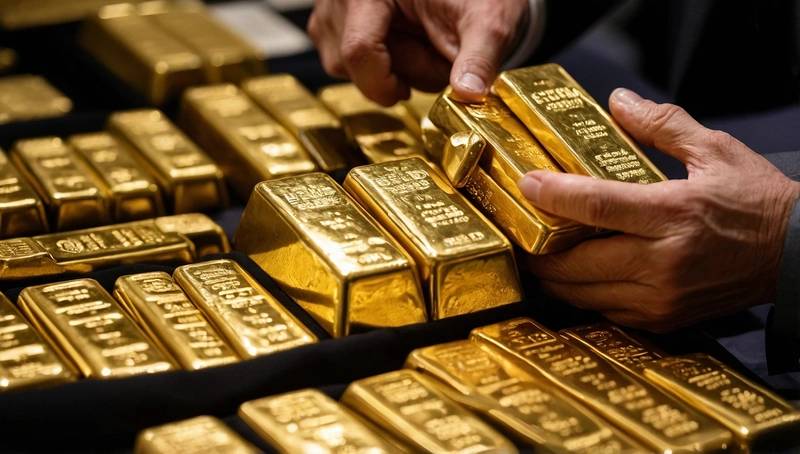
Gold prices rose on Tuesday, as the uncertainty surrounding President Donald Trump's proposed tariffs continued to dominate sentiment. This drove demand for safe haven assets amid fears of an escalating global trade war.
As of 0301 GMT, spot gold was up 0.2% at $2,903.56. U.S. Gold futures rose 0.6% to $2 916.80.
Kyle Rodda, a financial analyst at Capital.com, said: "There's a lot of central bank buying going on and we may also have shortages in Europe because there's a rush in the U.S. to buy gold to avoid tariffs."
"I believe the trend is bullish for gold. The fundamentals are sound."
Trump has implemented a 10% tariff against Chinese imports since his inauguration. He also announced and delayed a 25% tariff on goods imported from Mexico, as well as non-energy imports of Canada. Trump has set a date to implement a 25% tariff on imported steel, aluminium and other metals.
Michelle Bowman, the U.S. Federal Reserve governor, said that she wants to be more confident about inflation easing further this year. This is especially true given the uncertainty surrounding new trade policies and other policy changes.
Bullion has traditionally been used as a hedge against inflation and economic uncertainty.
Later in the day, two Fed officials will speak to provide further insight on monetary policy.
Goldman Sachs has raised its gold forecast for the end of 2025 to $3,100 an ounce, up from $2,890, due to structurally higher demand by central banks.
The European leaders who met in Paris on Monday called for increased spending to boost the continent's defense capabilities, but were divided over the idea of sending peacekeepers into Ukraine to support any peace agreement. Spot silver dropped 1.5% to an ounce of $32.30. Palladium rose 1.3% and platinum gained 0.7%. (Reporting and editing by Rashmi aich in Bengaluru, Anushree mukherjee from Bengaluru)
(source: Reuters)