
Latest News
-
Sources say that the Russian oil refinery in Ryazan has ceased operations following a drone attack on Sept. 6,
Two industry sources confirmed to? Two industry sources told? on Thursday. Ukraine continues to attack Russian energy infrastructure in an effort to?undermine the country's economy as?the conflict has been raging for more than four-and-a-half years. Vladimir Putin, the Russian president, has stated that these attacks are meant to create discord in Russia. Sources said that after the attack, the main unit of the refinery, CDU-6 as well as another primary unit CDU-4 were stopped. CDU-6 is capable of processing 8 million metric tonnes of oil annually, or 160,000 barrels a day. This accounts for almost half of the plant’s capacity. CDU-4 is capable of processing?4 millions tons of oil per year. Since mid-May, CDU-3 (another primary unit) has been undergoing maintenance. Sources said that the repair of damaged units could take several weeks. Rosneft has not responded to a comment request about the attack at the plant located 200 km (124 miles), southeast of Moscow. On May 15,?drones also attacked the Ryazan refinery that supplies fuel to Moscow. Sources said that the repairs?had been ongoing since mid-July. Sources said that it was also struck by drones on July 29, and operations have been halted for two to three weeks. According to industry sources the refinery will process 13.1 million tonnes of crude oil in 2024. This is about 4.9% of Russia's overall refining capacity. In that year, it produced 2.2 millions tons of gasoline and diesel fuel as well as 4.3 million tonnes of fuel oil.
-
Pakistan: No military response was discussed in the Mecca Pact regarding Houthi attacks against Saudi Arabia
Pakistani officials said on Thursday that they had not discussed a possible military response from Islamabad in accordance with the?Mecca Accords as a result of the Houthis attacks 'on Saudi Arabia. They added, however, that Pakistan will act when "the time comes". "There's no such thing being discussed right now." "There is no such thing under discussion right now... According to the joint defence agreement, signed last month, an armed attack against any?of three?countries would be considered an attack against all of them. This question was raised after Iran-backed Houthis attacked Saudi cities and energy infrastructure in the past week. By Thursday, these attacks had turned into a second Middle East theatre of war. Islamabad warned Iran that its Yemeni Houthi ally's were stepping up their attacks against Saudi Arabia. Pakistan has condemned the attacks, but it did not provide any details about how the country might respond under the terms of the defence pact. Khan said there was no plan to expand the Mecca Alliance, as Washington struggles to contain the regional turmoil that has disrupted the global energy supply.
-
Gold rises on the back of a weaker dollar and US inflation data are on the way
Gold rose on Thursday on a softer dollar, as investors waited for key U.S. data on inflation to get clues about the Federal Reserve's rate hike path. Gold futures in the U.S. fell 0.3%, to $4448.80 per ounce, and spot gold rose 0.1%, to $4405.09 an ounce, by 0824 GMT. Gold is benefiting from a slightly weaker dollar, because the yellow metal has a negative correlation with the greenback most of the time. This, combined with the global debt worries, continue to support the demand, said UBS analyst Giovanni Staunovo. As the U.S. Dollar index weakened, greenback priced bullion became more affordable for buyers abroad. The markets are now awaiting the U.S. consumer price inflation data scheduled for Friday, which will be followed by the producer price index data at 1230 GMT. Rhona O’Connell, Stone X's head of market research, said that if they missed the mark on the upside, there would be a hike in gold prices next week. A majority of economists polled believe that the Fed will likely hold interest rates at its meeting on September 15-16 and throughout this year. According to the CME FedWatch tool, traders still price in a 60% chance that rates will be raised next week. Donald Trump, the U.S. president, said that he expects the war with Iran will end after the midterm elections in November. He also threatened to attack another site linked with Iran's nuke programme. Brent crude prices were hovering above $100 per barrel. Treasury Department announced last month that the total U.S. government debt had surpassed $40 trillion for the first. This prompted new warnings of a fiscal emergency. According to a recent poll, the European Central Bank is likely to increase interest rates for the second time this year on Thursday, as policymakers try to curb an inflationary rise driven by energy. Silver spot fell by 0.2%, to $67.11 an ounce. Platinum dropped 1.2%, to $1873.84, while palladium was down 0.2%, to $1350.82.
-
Trump threatens to attack Pickaxe Mountain after he says the Iran war will end after US midterm elections
Donald Trump has said that he expects the war against Iran to end following the midterm elections in November. He also threatened to 'again' attack a nuclear site linked to the Islamic Republic after both sides launched their 'biggest wave of strikes on shipping since the beginning of the six-month war. Saudi civil defense authorities issued emergency alerts on Thursday in Khamis Mushait, a city in southwest Yemen, for the fourth consecutive day, after clashes with the Houthis, who are backed by Iran. Brent crude prices were above $100 per barrel, as both supply routes through the Strait of Hormuz (the Strait of Hormuz) and the Red Sea remained severely disrupted. Iran claimed that it had launched 10 attacks on Wednesday near the Strait of Hormuz after the U.S. destroyed five Iranian oil tanks. This was the latest of many tit-fortat strikes which have indicated that there is little chance of a rapid end to the hostilities. Trump's popularity has reached record lows due to the?war, and subsequent rise in fuel prices. The president claimed that Tehran is trying to influence November's U.S. midterm election, which will determine whether the Republican Party maintains control of Congress. "I believe war will end immediately after the elections because they cannot hold out anymore." "They're desperate to affect the election," Trump told reporters on Wednesday. Trump had previously set a deadline for the end of the war. The Wall Street Journal reported that later, top White House advisors, including Vice President JD?Vance and Secretary of State Marco Rubio had privately warned Trump that this conflict could last through his remaining presidency, which ends January 2029. Trump said that the U.S. could also strike Iran's Pickaxe Mountain. This heavily fortified area contains two deep-buried tunnel systems near Iran's damaged Natanz facility. "We've noticed that Pickaxe is a bit busy." Trump warned Iran to not be cute, because they will get hit very hard. He said this in a speech to the Republican midterm convention. Trump has been threatening to strike Pickaxe Mountain at least since mid-July. In February, the U.S. and Israel conducted military strikes against Iran partly because of concerns about Tehran's nuclear program. Iran claims its nuclear activities are peaceful. Washington cited in recent weeks?increasing successes guiding tankers across the Strait of Hormuz which carried around a fifth of the oil supply before the war. A resumption in fighting earlier this month appears to have set any gradual reopening back. On Thursday, preliminary data from ship tracking showed that only seven vessels had transited through the strait Wednesday. This is half of the average for the past 10 days. Saudi Arabia's war with the Houthis has escalated over the last few days. This is a second theater of conflict that threatens the global energy supply from the Middle East. The Saudi-led coalition reported on Tuesday that at least 73 people had been wounded in recent Houthi assaults on the world's biggest oil exporter in four southern Saudi towns, including Khamis Mushait. The militant group claimed that it attacked an airbase in the city of Khamis Mushait in the southwest and oil infrastructures in other cities nearby in one 'of the largest attacks on Saudi Arabia after the U.S./Israeli war against Iran in February. The Saudi Civil Defence authorities declared Thursday that the situation is under control following a second emergency alert in Khamis Mushait.
-
Sinopec's researcher claims that China could have 80% of its population using electric vehicles by 2030.
A researcher from the state-owned oil company Sinopec stated on Thursday that the penetration rate of electric vehicles in China is expected to rise, but at a slower pace towards the end of the decade. Continued growth in this sector will reduce oil demand from the largest crude oil importer in the world. Fairy Wang, vice president of Sinopec’s Economics and Development Research Institute, said at the APPEC Conference in Singapore that EVs are expected to displace 56?metric tonnes, or approximately 1.2 million barrels a day?of oil demand?in China. She said that "it is equivalent to about 15% of China's total demand for refined oil products." About two-thirds (or about 63%) of the demand for gasoline-powered cars is displaced by diesel vehicles. According to Wang, EV penetration reached 65% in China in July. This is up from 53% in the previous year, and only 5% by 2020. These figures include both plug-in hybrid and battery electric?vehicles. Wang claimed that nearly all public transportation vehicles in China are now electric. She attributed the rapid adoption of EVs to the previous government subsidies as well as the country's?"extensive" charging infrastructure. Wang stated that China has approximately 23 million 'charging stations. Around two thirds are home chargers and the rest are public charging facilities. More consumers are switching to electric vehicles because of the?availability?of charging infrastructure?in both large and small cities.
-
Singapore's Aster plans on increasing naphtha cracker usage, executive says
Aster Chemicals & 'Energy, Singapore's energy company, has run its naphtha cracker between?75% and 80% over the last five months. The company plans to increase utilisation rates even further. Andre Khor told the APPEC Conference that Aster will continue to ramp up and start supplying petrochemicals. Aster, a joint venture of Indonesia's ?Chandra Asri and trading major Glencore, operates a 1.1-million-metric-ton-per-year ?steam cracker on ?Singapore's Bukom Island. He added that the naphtha cracker resumed its operations in September's first week after being shut down for maintenance in August. Khor said the company is using naphtha ?from its 237,000-barrel-per-day refinery and studying the use of other feedstocks. Aster declared force majeure in March on some of its contractual deliveries, citing the disruption in raw materials caused by the U.S./Israeli war against Iran. After the Strait of Hormuz was almost completely shut down earlier this year, Glencore's global network allowed it to switch to crude oil from West Africa, Latin America, and Canada to fuel its refinery.
-
Morning bid Europe- Lagarde is the star of the show as oil rises above $100
Ankur Banerjee gives us a look at what the future holds for European and global markets Investors may be starting to realize that higher oil prices and elevated bond yields are the new norm as the Middle East war spreads in advance of central bank meetings, where policymakers might'struggle' to quell the markets' inflation anxiety. The European Central Bank is expected to kick off the central banking bonanza with a rate hike later today. Next week, the Federal Reserve will be followed by the Bank of Japan and the Federal Reserve. The focus will be on what comes next as ECB President Christine Lagarde addresses the audience in the aftermath of the largest wave of attacks against?shippings in the Middle East where the six-month conflict is escalating once again. Before the decision was made, the euro was stable at $1.1637. European stock futures indicated a muted opening. Brent crude futures are above $100 per barrel for the very first time since last July. Long-term bond rates have reached a high not seen since before the global financial crises. This toxic mix weighs on the sentiment, and there is no end in sight to a war which is likely to cast a dark shadow over U.S. Midterm Elections amid inflation concerns. The data on U.S. consumer prices will be released on Friday. Analysts expect the data to be a major factor in determining whether the Fed raises rates during its meeting on September 15-16. Fed funds futures traders are pricing about 60% odds that a rate increase will occur next week. What about the yen, then? The yen is up 4% in one month to 153.39 dollars, despite the increase in oil prices. Traders are bracing for an accelerated rate of rate increases from the BOJ. Kazuyuki masu, a board member, warned in a speech that was closely watched ahead of the policy meeting next week of "expanding price pressures" which have brought underlying inflation "very near" its 2% goal, hinting at a rapid rate increase. The following are key developments that may influence the markets on Thursday. Economic events: ECB Policy Meeting (A rate increase expected) Inflation data for August in Germany August U.S. inflation rate PPI
-
Trump urges Tehran to 'not get cute' after he says that he has seen activity at Iran's Pickaxe Mountain
On Wednesday, President Donald Trump stated that the United States could strike Iran's Pickaxe Mountain and urged Tehran to be "cautious". "We've noticed that Pickaxe is a little busy." Trump told the Republican Convention that he would advise Iran to not be cute, because they will have to be hit very hard. Pickaxe Mountain is located near Iran's badly damaged Natanz uranium-enrichment facility. It has two deep-buried tunnel systems. Trump has been threatening strikes on Pickaxe Mountain at least since mid-July. Trump and the Republican Party are concerned about the rise in gas and oil prices as a result of the U.S. and Israeli war against Iran in the run-up to November's midterm elections. U.S.-Israeli'strikes on Iran and Israeli attacks on Lebanon have killed thousands and displaced millions. U.S. and Israeli?strikes against Iran and Israeli attacks on Lebanon have caused thousands of deaths and millions to be displaced. Trump said that he believed the war would end after the midterm elections, and that Tehran was trying influence the elections which will determine whether Republicans maintain control of Congress. Pickaxe Mountain is located 220 km (140 mi) south of Tehran, and only 2 km away from the Natanz complex. In March, the U.S. and Israeli military attacked Iran, including Natanz, which was home to two Iran's uranium-enrichment plants. Israel also struck Natanz in last year's 12-day Israel - Iran war. According to the Institute for Science and International Security (a U.S. think tank focusing on non-proliferation), "the tunnel facility under construction" at Pickaxe Mountain wasn't targeted during either of these wars. Trump's war objective is to weaken Iran's nuclear capability. Iran claims it does not possess nuclear weapons, and that its uranium-enrichment program is only for peaceful purposes. The U.S.?is a nuclear power. Israel is widely believed to be the sole nuclear-armed nation in the Middle East, but it has never confirmed or denied this publicly.
Two dead, homes burn in massive wildfire in Cyprus
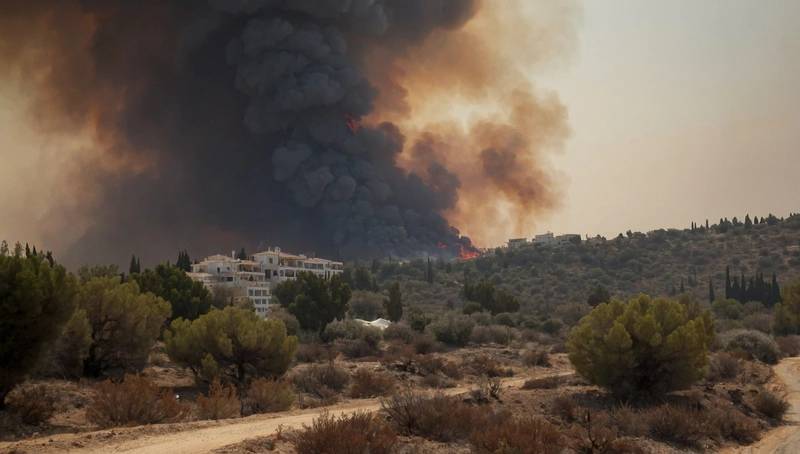
A massive wildfire ravaged southern Cyprus, destroying houses and threatening local communities in the midst of an intense heatwave.
The fire broke out at midday on Wednesday in an area that produces wine north of Limassol. On Thursday morning, several fronts were still active.
Two bodies were discovered in a burnt-out car, trapped by fire. Police said that at least 10 people, including two seriously injured individuals, were hurt.
As dawn broke, the reddish hue of Limassol hung in the air. This sprawling city on Cyprus's coast has seen its development spill over into the mountains surrounding it. After a brief pause due to darkness, firefighting aircraft returned at first light.
The authorities said that it was still too early to provide a detailed account of the damage or what caused the fire.
Andreas Kettis, spokesperson for the fire brigade, said: "We were talking about very strong wind gusts that were constantly changing."
On Wednesday, temperatures on the island reached 43 degrees Celsius (109.4 F) triggering a weather alert. On Thursday, a new amber alert was issued with temperatures forecast to reach 44 degrees Celsius. This is the highest temperature of the year.
Konstantinos Letymbiotis, the government spokesperson, said that Cyprus had requested assistance through the Civil Protection Mechanism of the European Union. Spain is expected to send at least two aircrafts on Thursday. Jordan has also offered assistance.
Cyprus has been suffering from a prolonged drought that has pushed water resources to critical levels. The area affected is located just north of Cyprus’s largest reservoir, Kouris. On Wednesday, it was only at 15.5% capacity. (Written by Michele Kambas. Yiannis Koutoglou contributed additional reporting. Christopher Cushing, Mark Potter (Editors)
(source: Reuters)