
Latest News
-
Oil prices continue to fall as concerns about Middle East supply disruptions diminish
Early Thursday morning, oil prices continued to fall, adding to the previous day's losses. This was due to reports that Saudi Arabia offered extra crude cargoes via Oman, which reduced concerns about supply disruptions. Brent crude futures fell $1.24 or 1.2% to $104.59 a barrel at 0049 GMT. U.S. West Texas intermediate futures were down by $1.14 or 1.1% to $101.29. Both contracts dropped about $3 on Wednesday. Hiroyuki Kikukawa is the chief strategist at Nissan Securities Investment. He added that "expectations of progress towards easing tensions in the Middle East before the U.S. China summit next week also cap price increases." People familiar with the situation said that Saudi Arabia offers'more' loadings of crude to Asian refiners through ship-to-ship transfers at Oman's Sohar Port, reducing some 'of the damage to global supply caused by attacks on Saudi Arabia's East West pipeline to the Red Sea. The price of oil rose this week to a four-month high after sources in the shipping industry reported that crude loadings had been suspended at Saudi Arabia's Red Sea Export Hub, Yanbu. Riyadh also cancelled certain cargo deliveries to European clients. The suspension was a result of attacks on the East-West Pipeline, which supplies the Saudi port Yanbu. Yanbu was Saudi Arabia's primary oil export outlet after Iran blocked the?Strait of Hormuz following the U.S.-Israeli attack on the country in February. Hormuz used to be the source of one-fifth the world's oil before the war. Three oil and security sources have reported that two pumping stations servicing the East-West Pipeline were damaged by an attack last week. However, a timeline for repair is not clear. Even though the price of oil fell on Thursday, concerns about a Middle East war that is intensifying remain. Saudi warplanes bombarded Yemen, and Houthi fighters fired drones and missiles at Saudi cities. The Iran-backed movement announced this on Wednesday. This comes after a rapid advance which has increased Tehran's influence in the Middle East?war. Meanwhile, the U.S. Energy Information Administration ?on Wednesday reported a smaller-than-expected draw from U.S. ?crude inventories last week. The EIA data revealed that crude oil inventories in the nation's top producer fell by 640,000 barrels during the week. This was less than the 1.62 million barrels expected according to an energy analyst poll.
-
US House passes first bill to address economic impact of data centers boom
The U.S. House of Representatives voted on Wednesday to protect households from a rise in electricity costs due to the expansion of data centres. This is the first time the chamber has passed legislation that directly addresses economic concerns related to the growth of the industry. The Republican majority House voted in favor of Ratepayer Protection Act by 417 votes to three. This act would require state utility regulators consider whether large electricity consumers, such as data centers, should be responsible for the incremental costs associated with power infrastructure built to service them. The vote underscores the complex politics surrounding the U.S. Data center boom. Donald Trump, the U.S. president, strongly supports?data centers as a critical component of artificial intelligence leadership. He said earlier this week that data centers are the "oil" of the next 20 to 25 years, making people and states rich. Both parties are facing growing concerns from their constituents about the rising costs of electricity due to the booming power demand in the industry. House Republican leaders moved this bill before the lawmakers left Washington for the midterm elections on November 3. Robert Garcia, a California Democrat and U.S. representative, stated in advance of the vote that although it was not enough, it would receive significant support from those who hope more reforms will follow. He said that the House Republicans were trying to take a stand on the data center issue. However, "the truth is, they have done absolutely nothing about it." "I believe a lot of their base voters are angry. This is not the protection that people need. According to a recent poll conducted by the University of Massachusetts Amherst, only 11% of Americans would support building an AI data center in their community.
-
Bloomberg News reports Holtec Nuclear has suspended its planned US IPO.
Bloomberg News reported on Wednesday that Holtec Nuclear had suspended its planned U.S. Initial Public Offering, citing "people familiar with the matter". A report citing a person said that the IPO had been put on hold due to market conditions. Holtec didn't immediately respond to an inquiry for comment. Could not verify the report immediately. The company's listing was expected to be the most popular during the first week of the autumn window. This is traditionally the busiest time for new listings. Holtec wanted to raise up to $900'millions by selling 50 million shares at between $15 - $18 a piece in its IPO. The price was expected on Thursday. The latest blow to the issuers in the nuclear sector is a postponement. Their stocks have been on a downward trend over the past few months. Standard Nuclear's shares have fallen 20.6% since the IPO price on July 1st. X-Energy is trading at 36.7% less than its IPO price. Holtec was founded in 1986 by Krishna Singh and specializes in a number of areas, including heat transfer, reactor components, spent-fuel storage, and decommissioning nuclear plants. Holtec is also developing small modular reactors, with the first two units to be installed at its Palisades facility.
-
US DFC approves EUR85 Million Loan to Ukraine's DTEK
DFC and DTEK announced on Wednesday that the U.S. International Development Finance Corporation approved a EUR85 million (USD 97.5 million) loan for Ukraine's largest energy private?company DTEK to expand their?battery?storage. The DFC has made the largest loan to Ukraine's energy industry since the beginning of the Russian invasion in 2022. Maxim Timchenko is the chief executive officer at DTEK. He said, "This EUR85million loan allows us to release more funds for building more battery storage projects and other projects." "For me, I think the financial aspect is important, but it's more significant that DFC is willing to support Ukraine and DTEK." He said, "They have done an assessment of risk and know how to manage it. They are telling private investors that they should follow." Ben Black, the chief executive of DFC, said in a press release that "U.S. DFC was authorized to invest by President Donald Trump. These projects will secure vital infrastructure and resources across Africa, Central Asia, Ukraine, Jordan and Jordan and help U.S. firms compete in some of the world's most important markets. DTEK belongs to SCM Holdings. Rinat Akhmetov is the sole shareholder of SCM Holdings and its ultimate beneficiary. DTEK opened Ukraine's largest storage facility for batteries last year to "ensure stable" power supplies, as Russia had repeatedly targeted Ukrainian energy infrastructure in missile and drone strikes during the more than four years of war. Six battery storage systems were?connected to the power grid of the capital Kyiv and the Dnipropetrovsk Region in Eastern Ukraine. The 'facilities', built in partnership with Fluence, an American battery storage technology company, can store 400 megawatts of electricity, enough to power 600 000 Ukrainian households for 2 hours.
-
US Senators ask for more information about Trump's Saudi nuclear plan, says letter
Democratic and Republican U.S. Senators on Wednesday asked President Donald Trump's administration to declassify?and release?all information regarding a?proposed?agreement?with Saudi Arabia?on civil nuclear energy?, including?two classified?side letters?agreed with Riyadh? The senators wrote to Secretary of Energy Christopher Wright and Secretary of State Marco Rubio, noting that the government had reached dozens such agreements, also known as the 123 Nuclear Agreements, with other countries, without hiding any information. The letter stated that "access to the full text" was required to ensure that the Senate and public had a clear understanding about the commitments made on behalf of the United States and Saudi Arabia. Requests for comments from the Departments of State and Energy were not immediately responded to. The letter was written by Democrats Jeff Merkley and Ed Markey from Oregon and Massachusetts. It also included 13 other Democratic Senators, an independent who caucuses with Democrats and two Republicans: Rand?Paul from Kentucky and John Kennedy from Louisiana. Trump sent a proposed agreement with Saudi Arabia in August to Congress, giving lawmakers 90 days to review it and to consider a resolution disapproving the deal. Since then, lawmakers have been pressing for the declassification and release of documents related to the side letters that were reached in conjunction with the proposed deal. Nuclear agreement also raises questions as to whether Saudi Arabia will get the deal if normalized relations with Israel are not achieved. Trump said that it would only 'go into effect' if Riyadh did so. However, congressional aides said there was nothing in the pact which addressed?that question. The letter sent on Wednesday didn't mention Israel. The 30-year deal includes the construction of AP1000 nuclear reactors. This is a 'project worth tens and tens billions dollars, which would benefit Westinghouse. Democrats and nonproliferation activists have criticised the nuclear pact because it does not prohibit Saudi Arabia from enriching uranium, or reprocessing its nuclear waste. These are two potential ways to make a nuclear bomb. The United Arab Emirates accepted such measures, also known as the "gold standard", in their 2009 civil nuclear agreement with Washington. The Trump Administration says that the deal contains non-proliferation provisions required by law.
-
Brazil diesel imports are at risk due to a rise in global prices and a widening Petrobras price gap
The gap between international diesel prices and Brazil's state owned oil company Petrobras has reached record levels due to a recent rally in international diesel prices. Industry executives have said that independent importers are delaying purchases because of this. Petrobras diesel prices were $0.79 per liter less than import prices according to Abicom. This was despite the fact that local production had reached its maximum. Sergio Araujo, Abicom's President, said that Brazilian refineries are currently operating at close to capacity. Brazil imports about one-quarter of the diesel it consumes. Petrobras, which is part of Brazil's Luiz Inacio Lula Da Silva, has been working to reduce diesel prices since the beginning of the U.S. - Israel conflict with Iran. They have done this by boosting the domestic supply, and by participating in the Brazilian president's subsidy program to combat inflation before the October election. Lula da Silva wants to run for another term. Petrobras' profitability is hurt when it imports diesel at higher prices abroad than what it charges domestically. This squeeze on margins also reduces the incentive for other importers. In recent weeks, international oil prices have risen. Brent crude reached $108 per barrel on Tuesday. This is up from $93 at the beginning of the month. U.S. Diesel futures also hit a record due to Middle East conflict and Russian export restrictions. LOCALIZED DISRUPTIONS As the planting of the summer crop is underway, the Rio Grande do Sul agriculture federation, Farsul, reported to Brazil's fuel regulator ANP that there were delays and restrictions in diesel deliveries for farmers in the southern states. According to a person who works with fuel distributors, customers from neighboring countries that depend more on imported diesel are seeking it in Rio Grande do Sul, which could be straining the local supply. ANP stated that diesel deliveries were proceeding as usual and that it had not yet identified any risk of a supply shortage in Rio Grande do Sul. Petrobras stated that its deliveries were proceeding "as planned" and that all volumes contracted are being delivered. Localized fuel shortages and bottlenecks in the logistics system are similar to what was seen earlier this year, but widespread shortages of fuel remain unlikely. Bruno Cordeiro is a StoneX market intelligence specialist. He said, "The market is tighter, but there are no concerns about supply disruptions."
-
SEC wants to stop monitoring shareholder votes, which is a blow for reformers
The U.S. Securities and Exchange Commission proposed on Wednesday to 'end its oversight of corporate shareholders votes?on topics such as climate change or executive compensation, a move that critics see as a blow to corporate reforms. The move is part of the SEC's broader power shift away from investors and towards corporate managers. It was expected since last month. Wall Street's top regulator has also proposed changes, including the end of a rule that requires companies to produce glossy annual reports. In a recent statement, SEC chairman Paul Atkins stated that the SEC lacked the statutory authority to supervise shareholder voting. This area was best managed by the states. Texas is one of the states that has offered favorable treatment to companies who incorporate locally. Atkins stated that "as we are experiencing an exciting period of increased competition among states for corporate domicile," it is the perfect time for the Commission, in relation to state law, to acknowledge the limits of their authority for regulating shareholder proposal. Many corporate annual meetings have focused on investor resolutions that address topics such as carbon emissions, diversity in the workforce, or executive roles. However, this number has decreased over recent years. Activists are concerned that the SEC’s decision to 'dismantle' long-standing processes could diminish their influence in areas like?environmental matters or CEO pay. Now, the proposed changes will be subject to public comments and further SEC action. In a recent statement, New York State Comptroller Thomas DiNapoli (who oversees the state retirement funds) said that "for more than 80 year, shareholder proposal has been a cornerstone in American corporate governance, which has strengthened board oversight and improved risk management and fostered productive dialogue between investors, companies and their shareholders." DiNapoli stated that the SEC's proposal allows corporate management to escape accountability.
-
Media reports claim that a suspected London "Putney Pusher" has been found dead.
British media reported that the man suspected to be the "Putney Pusher" who allegedly pushed a woman in the path of a bus nine years ago in London in a'mysterious incident' which received a lot of publicity has died. The reports stated that Nicholas Brandram, 44 years old, was arrested in June under suspicion of grievous body harm in relation to the incident, which took place on Putney Bridge on May 17, 2017. Closed circuit TV captured the moment that a 33-year old woman was pushed to the ground by a jogger on the bridge. Her upper body and head fell into the path an oncoming bus, which managed to swerve away from her. The incident drew a lot of media attention but no suspect or motive was ever found. Media reports claimed that Brandram, who was a descendant from Queen Victoria and had been arrested for drug possession, has now been found dead in his west London home. London Police confirmed in a press release that a man was found unconscious at an address 'in Chiswick' on Tuesday. The 44-year old man was declared dead on the spot. The statement stated that his next of kin had been notified. At this time, his death is being treated as unexpected but not suspected. British?media reported that Brandram is a 'grandson of Princess Katherine?of?Greece & Denmark', has served in the British Military and worked for HSBC Private Banking.
DEME Gets Multi-Million Dollar Inter-Array Cabling Job at Dutch Offshore Wind Farm
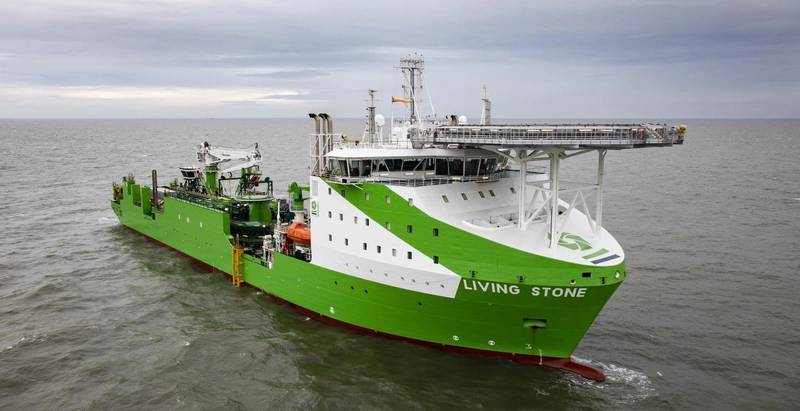
Belgium-based offshore installation services company DEME has secured a contract, worth up to $320 million, to carry out the transport and installation works for the inter-array cables and secondary steel for the OranjeWind offshore wind farm in the Netherlands.
With an installed capacity of nearly 800 MW, the wind farm is being developed by a joint venture of RWE and TotalEnergies. DEME will transport and install a total of 114 km of inter-array cables, which will connect all 53 foundations to the offshore substation in the Dutch North Sea.
The extensive scope includes all the engineering, preparation and supporting activities, ensuring that DEME will deliver a complete solution to RWE and TotalEnergies.
Pre-sweeping will be conducted at the wind farm, situated 53 km from the Dutch coast, before cable installation in areas with significant sand waves to ensure the cable is buried at the required target depth.
At the offshore substation and crossings of existing assets, the cables will be stabilized with rock.
The secondary steel scope includes the transport and installation of boat landings, access platforms and internal platforms at the monopile foundations.
Scheduled to start in the second half of 2026, DEME will deploy offshore and cable installation vessels, a hopper dredger and fallpipe vessel, as well as additional supporting equipment.
“This latest contract award highlights DEME’s ability to provide a comprehensive range of solutions to the offshore wind industry. With our diverse offshore fleet and specialised equipment, we are well positioned to successfully deliver this project, while working closely with the RWE and TotalEnergies joint venture.
“Additionally, the project will benefit from DEME's extensive experience in cable installation, particularly given the dynamic seabed environment at the wind farm location. We are also excited to collaborate with RWE and TotalEnergies, two leaders at the forefront of advancing the energy transition through innovative solutions,” says Philip Scheers, General Manager Subsea Power Cables at DEME.
This is the fourth cable project DEME has been awarded in recent months. DEME won two contracts from Prysmian for the engineering and installation works for TenneT’s IJmuiden Ver Alpha and Nederwiek 1 offshore grid systems in the Netherlands.
As well as this, a consortium consisting of DEME and Hellenic Cables, won a major contract for the supply and installation of the high-voltage subsea cables for the Princess Elisabeth Island in the Belgian North Sea.