
Latest News
-
Copper prices fall as demand fears and interest rates weigh on expectations
Copper fell on Thursday, after hotter than expected U.S. data released the day before sparked fears that interest rates would rise for longer and reduce demand. Benchmark 'three-month copper' on the London Metal Exchange fell 0.22% to $14,586.5 per metric tonne at 0317 GMT. The Shanghai Futures Exchange's most traded copper contract fell 0.52%, to 110,750 Yuan ($16.494.89) per ton. Analysts at Chinese broker Galaxy Futures stated that economic data showed US business activity increased to a five-year high level in September. This put pressure on copper prices. According to CME's Fedwatch, rate traders now price in a 72% probability that the US Federal Reserve will raise interest rates at its October meeting. This is up from just 49% one week ago. Oil prices fell elsewhere after Iran declared it was "open to diplomacy". This provided some reassurance following a statement made by an Iranian official Wednesday that Iran and the U.S. are still far apart on peace talks. The war has increased energy prices, causing inflation and the threat of interest rates that will remain higher for longer. This can dampen demand by stifling growth. The red metal was lifted this week due to strong Chinese buying in advance of the national holidays. However, dollar gains and profit-taking drove it down from its near-record levels. The Yangshan premium copper The price of copper, a measure of China's appetite to import it, was unchanged on Wednesday. It stood at $117 per ton. This is 62.5% more than the beginning of the month. Aluminium fell 0.45% on the LME, while zinc dropped 0.24% and lead declined 0.18%. Nickel also dipped by 0.16%. Tin was barely changed. It only rose 0.04%. Lead fell 0.82% and nickel 0.79%. Tin dipped by 0.25%.
-
US and Indian top diplomats talk about Russia sanctions bill signed Trump
US Secretary of State Marco Rubio, and Indian Foreign minister?S. Jaishankar and New Delhi discussed US measures against countries that do business with Russia or Iran on Wednesday. Trump signed a bill last week called the "Lindsey O. Graham Act of 2026 Sanctioning Russia & Iran", named after South?Carolina Republican US senator Lindsey Graham, who died in 2016. The US Congress passed a bill that increased the economic pressure on Russia for its invasion of Ukraine, which began in early 2022. Rubio and Jaishankar discussed sanctions that could be imposed against states that do business with Russia and Iran, the State Department stated in a press release following their meeting in New York. Jaishankar wrote 'on X he reiterated India’s interests and concerns in regard to SRIA. India warned Washington that new tariffs on Russian oil purchases could have a negative impact on bilateral relations. The bill mandates that Trump impose tariffs up to 100 percent within 30 days for all goods imported to the US by the top five importers of Russian crude or gas, as well as from any country who knowingly purchased new oil or natural gas 30 days after?the law was enacted? or helped Russia evade sanctions. India is one of the largest buyers of Russian crude oil. India 'increased its purchases of Russian discounted crude after Russia invaded Ukraine. Trump's hefty tariffs on Indian goods, which could reach as high as 50% in August 2025 due to the increased purchases of discounted Russian crude were partly a result of the increased purchases. Trump lifted these duties in February, citing India's pledge to stop Russian oil purchases. New Delhi only reduced its purchases of Russian oil briefly in early 2026. Since then, they have risen dramatically, particularly since the supply shock following the 'US-Israeli War on Iran. India's?large population? and?growing economy? need affordable energy? supplies. Indian analysts claim that India's purchases from Russia of oil did not finance the war in Ukraine, but helped stabilize global supplies while keeping domestic prices under control.
-
Elmet signs tungsten supply agreement with Masan High-Tech, Vietnam
Vietnamese tungsten manufacturer Masan High-Tech Materials announced on Thursday that it would sell a 4,99% stake to US-based tungsten product supplier Elmet Group. The deal valued the company at approximately $2.5 billion. Masan 'High-Tech has also agreed to "supply" and process approximately 1,250 metric tonnes of tungsten equivalent per year for Elmet, under a contract lasting at least eight years. At current prices, the agreement is expected generate gross revenues of about $1.5 billion. After the announcement, shares of Masan High-Tech rose by 7% in the morning on Thursday. Many countries classify tungsten, an extremely tough metal, as a critical material. It is used in electronic and defence applications, including semiconductors and ammunition. Masan High-Tech is the owner of Nui Phao, which is one of the largest tungsten mines in the world outside of China. It accounts for almost all of Vietnam's annual estimated tungsten production of 3,400 tonnes. According to the U.S. Geological Survey, Vietnam will be the second largest tungsten producer in the world after?China by 2024. In June, the company announced plans to expand the Nui Phao mine and nearby Nui Chiem area, potentially adding 115 million tons of tungsten-polymetallic resources as it seeks to expand its role in the global critical-minerals supply chain. Masan High-Tech stated that the transaction was a 'first step in its strategy of building long-term partnership with customers who seek secure tungsten supply, and it would continue exploring'similar partnerships in key market. The sale of Elmet's stake, which is still subject to regulatory and corporate approvals (and may take longer), should be completed by the end of the first month of October. After the transaction, Masan High-Tech’s parent, the conglomerate Masan Group will remain the controlling share-holder with approximately 87.46% ownership. Elmet manufactures tungsten, precision components, and high-energy systems in Maine, Michigan, and Ohio. It won a contract from the US Defense Logistics Agency worth up to $2 billion last week. The contract is meant to rebuild the National Defense Stockpile as well as boost US tungsten supplies. Jefferies Singapore was the exclusive financial advisor to Masan High-Tech.
-
Oil drops from highs, bonds are shaky amid trade and peace talks
Investors weighed the'simmering Middle East tensions' and prospects of a 'talk between China and the United States. Tokyo's markets opened?after?a three-day break, and the 10-year Japanese government bonds yield shot up to a 30 year high following a sharp sell-off overnight in the U.S. The greenback and oil prices both eased off recent highs after the leader of Iran vowed that they would never give up following Donald Trump's warning to "annihilate Iran". Investors waited for future rate hike signals from central bank speeches, economic releases and U.S. unemployment claims. The market was also focused on a summit between Trump and Chinese president Xi Jinping, hoping for progress in trade relations. Ray Attrill said in a podcast that "equities are showing signs of creaking" under the weight of ever-rising bonds yields. Attrill is the head of FX Strategy at the National Australia Bank. In a risk-off climate, the U.S. Dollar still appears to be a safe haven. The MSCI Asia ex Japan index fell by 0.64% while Japan's Nikkei rose by 1.73%. The benchmark S&P/ASX 200 index fell 1.2%, a drop of more than three months. Xi’s first visit to the U.S. after nearly three years is not expected to bring major breakthroughs. However, Washington?and Beijing may extend their 11-month trading truce. ?Scott Bessent, Treasury Secretary, said that they had agreed on a new extension while Trump personally welcomed Xi at Joint Base Andrews. The bond yields are at multi-year highs, as traders factor in the possibility of central banks raising interest rates to combat persistent inflation. The yield on Japan's 10-year bond rose 8 basis points to 3.06%. This is the highest level since August 1996. The 30-year yield increased 5.5 basis points to 4.12%. The 10-year Treasury yield in the United States remained at 5.11% after overnight reaching its highest level since 2007. Officials at the central bank maintained a "hawkish" tone, as rising oil costs exacerbated inflationary pressures. Federal Reserve Governor Michael Barr stated on Wednesday that the recent rate increase was part of an effort to recalibrate lending costs. He also indicated that more increases could be required. The markets are looking forward to speeches from other Fed officials, such as New York Fed president John Williams and Fed president Beth Hammack on Thursday. The geopolitical tensions pushed up energy prices. Iranian officials spoke with U.S. ambassadors at the UN General Assembly but neither side made any progress in ending the conflict. Trump reaffirmed his threats of escalation while Iran's President vowed to not yield. Brent crude dropped 1% to $102,05 per barrel. U.S. West Texas Intermediate fell 0.74%, down to $91,48. Gold spot rose 0.35%, to $4.301.89 per ounce. The dollar index dropped 0.04%, to 101.09 while the euro fell 0.02%, to $1.14. The Japanese yen rose 0.24%, to 157.91 dollars. The U.S. Labor Department will likely report that initial claims for unemployment rose to a likely 201,000 in the week ending September 19. Meanwhile, continuing claims are likely to have increased by 15,000 to 1.745 millions the previous week. The U.S. Labor Department is expected to report that initial jobless claims likely rose to 201,000?in the week ended September 19, while continuing claims likely increased 15,000?to 1.745 million in the prior week. European futures are lower. Euro Stoxx futures declined 0.33% at 6,304.00. DAX futures slipped 0.33% at 25,525.00. FTSE Futures fell 0.35% at 10,739.50. Ether rose 0.46% to 2,683.24, while Bitcoin grew 0.07% to $84 288.53.
-
Iran declares it is willing to negotiate to end the conflict, lowering oil prices
Oil prices fell on Thursday after rising 4% the previous day.?Iran stated that it was open to diplomacy in order to end the US/Iran conflict, but the two countries are still far apart as to how to achieve this. Brent crude futures dropped 94 cents or 0.9% to $102,13 per barrel. West Texas Intermediate futures declined 59 cents or 0.7% to $91,56. Iran and the United States are divided over how to end their war. Diplomacy, however, must continue. A senior Iranian official said. Iran's President told the UN General Assembly on Wednesday that Tehran will never yield to US pressure. The official stated that Tehran was reviewing Washington's response regarding its peace proposals. These include lifting the US naval blockade of Iranian ports and reopening of the Strait of Hormuz. The official stated that during indirect talks on Tuesday the reopening of Strait of Hormuz, and the lifting of Washington’s naval blockade against Iran were discussed. Mohsenrezaei, Iran's chief of security, said earlier on Wednesday that the Strait of Hormuz will not reopen until Iran's demands are met. US Secretary of state Marco Rubio said to reporters on Wednesday, that a deal would require hard work and patience over time. He added that Trump had other options. The traders also evaluated the possibility of limiting diesel exports. The price of ultra-low sulfur diesel futures fell by about 5% at midday after Politico reported that the Trump administration had plans to impose a 90-day ban on diesel. However, the White House has denied this. Bloomberg, citing sources, reported that Chris Wright, Energy Secretary, had told the oil industry to prepare for possible US restrictions on diesel exports during a call late Tuesday. Wright had said on Wednesday morning that a ban on diesel exports would not work, despite the fact that US President Donald Trump has said he will support it. Market watchers and analysts have warned such a move would do little to reduce high energy prices, and could worsen the global supply and further disrupt economies. The Energy Information Administration reported that US crude oil inventories increased by 3 million barrels, to 426.4 millions barrels, last week. The analysts polled had predicted a draw of 641,000 barrels. Fuel stocks fell.
-
UK pledges PS331 Million to Address Climate-Linked Security Risks
The UK announced on Wednesday that it would provide PS331,000,000 ($438.24,000,000) to tackle climate change, biodiversity loss and instability. It warned that environmental shocks were increasingly becoming a threat to national security. The funding will go to the Global Environment Facility, which supports food and water security as well as protecting ecosystems in the Amazon Basin and Congo Basin. This announcement comes after UK Foreign Minister Ed Miliband, on the sidelines the UN General Assembly, called for world leaders to consider climate change when assessing their national security risks. He said that climate change, ecological collapse, and intelligence networks should be incorporated into defense strategies, strategic military planning, and intelligence networks. Miliband stated that "countries must pool their information, because a shock in one country can quickly 'travel' through the supply chain, financial markets and migration patterns into other countries." Climate security is a hot topic as oil and gas prices have risen due to the Iran War. This has led some countries to increase their coal use, which is a major contributor to?carbon emission, while other countries are adopting more solar energy and electric vehicles. Katie White, UK's Minister for Climate?Transition, said on the sidelines the UN General 'Assembly, that the 'UK is leading the way' in focusing countries' attention on climate security, ahead of the COP31 climate'summit' which starts on November 9th, in Antalya. She said that the military has "always been in front of climate risk planning" because it's?always recognized climate change as a threat multiplier. "The security community is a little behind on this."
-
Kyiv is under Russian missile attack. One dead and two injured, the mayor claims
Vitali Klitschko, the mayor of Kiev, said that Russian forces launched ballistic missiles at the Ukrainian capital early Thursday morning. One person was killed and two medical personnel were injured as debris fell on various districts. "One dead and 2 injured in the capital." Klitschko posted on Telegram that both the wounded are medics who are currently being treated at a hospital. Klitschko stated that debris had fallen in three districts and a part of a house was destroyed. Klitschko wrote: "In the Dniprovskyi District, debris fell onto the yard of a privately owned property." People may be trapped beneath rubble. He advised residents to remain in shelters. Witnesses reported that several explosions resounded around 1 a.m. Unofficial 'Telegram' channels showed a fire that was said to be lighting up the horizon. According to Klitschko, Russian forces 'continued their attacks against the city throughout Wednesday, killing two and injuring 45 people.
-
Venezuela's Rodriguez promises to hold elections in order to transition into a 'full democratic'
Delcy Rodriguez, Venezuela's interim president, told the UN General Assembly on Wednesday the country will hold elections as part of the transition to "full democracy" but she did not give a date. "I want this to be very clear in this General Assembly: There will be elections for Venezuela," said Rodriguez. He came to power in January after American forces had captured Nicolas Maduro, then the President of Venezuela. Rodriguez stated that the government would ensure 'the participation of all political parties' in her remarks. She also added that the national institutions were being prepared for?the electoral process. Rodriguez said that Venezuela has begun a democratic transformation process for its rebirth. This is an orderly process with institutional checks and balances. The goal is to build a more prosperous country, one where everyone can live in freedom. Critics claim that Washington has marginalized the Venezuelan opposition by dumping its demands for free and fair elections in favour of oil and investment agreements with the interim government. Some US legislators have also called elections amid criticisms that the Trump Administration has failed to obtain meaningful democratic concessions? from Rodriguez's Government. "We've opened a dialogue with the opposition to create a process that is fair for everyone," said Rodriguez. Rodriguez met briefly with US President Donald Trump Tuesday on the sidelines of the?the UN?General Assembly and praised him on his decision to restart dialogue with Venezuela. Trump and Rodriguez discussed, among other things, restructuring the South American nation’s sovereign debt of billions. Rodriguez said that the economic recovery will "take time" but warned that it would take time. Rodriguez called for the support of the international community as it moves away from "a phase of uncertainty and conflict towards a full democracy."
Nexans Plans $99M Facilities Upgrade to Support European Offshore Wind
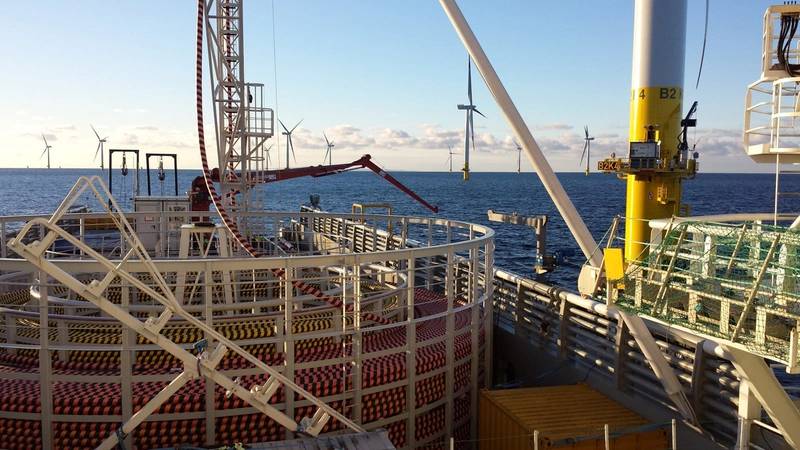
French subsea power cable maker Nexans has unveiled plans to invest $99 million (€90 million) in the construction of new and the upgrade of existing facilities to support the development of offshore wind and subsea interconnections in Europe.
The investment will include the construction of a new, 53 meter tower for the insulation of onshore cables at Nexans’ plant in Charleroi, Belgium and will allow for the production of 3,000 mm2 525kV HVDC onshore cables necessary to support TenneT’s three grid projects, BalWin 3, LanWin 4, and Lanwin 2 under the frame agreement signed in 2023.
Also, the investment will support upgrades to the cable manufacturing process such as a new stranding line and a degassing system specifically designed for HVDC cables and a new aluminum drawing line to increase our volume of aluminum wire production.
While the majority of the investment will be directed at upgrading its manufacturing plant in Charleroi, Nexans’ other facilities will also get a boost including a new HVDC lab with a hall specifically built for 525kV HVDC testing at its Calais facility in France, and a new injection press at its power accessories facility in collaboration with teams in Erembodegem, Belgium.
The investment will begin in 2025 and run through 2026 when the work is completed.
The Charleroi plant will also connect to the La Sambre channel which will allow Nexans to reduce transportation CO2 emissions by 85%.
“We are pleased to announce this new investment reinforcing our position as a leader in the energy transition. The ability to produce land cables up to 525kV is a game changing capability that will enable us to drive the transition forward for years to come. We are looking forward to completing this critical upgrade in our infrastructure to keep pace with the ever-increasing electricity demand globally,” said Pascal Radue, EVP of Nexans’ Generation and Transmission Business Group.